Another batch of trail camera photos
Who doesn't like looking at these awesome photographs of Alaskan wildlife? Our third week of camera trapping has come and gone. Check out this set of photos we've captured over the last couple weeks:
Coyote! The first one we've seen on our trail cameras this year, but coyotes are everywhere around this area. Why? Well, for one thing, there aren't many wolves here. Wolf packs usually keep coyote densities low. Without wolves, coyote populations explode.

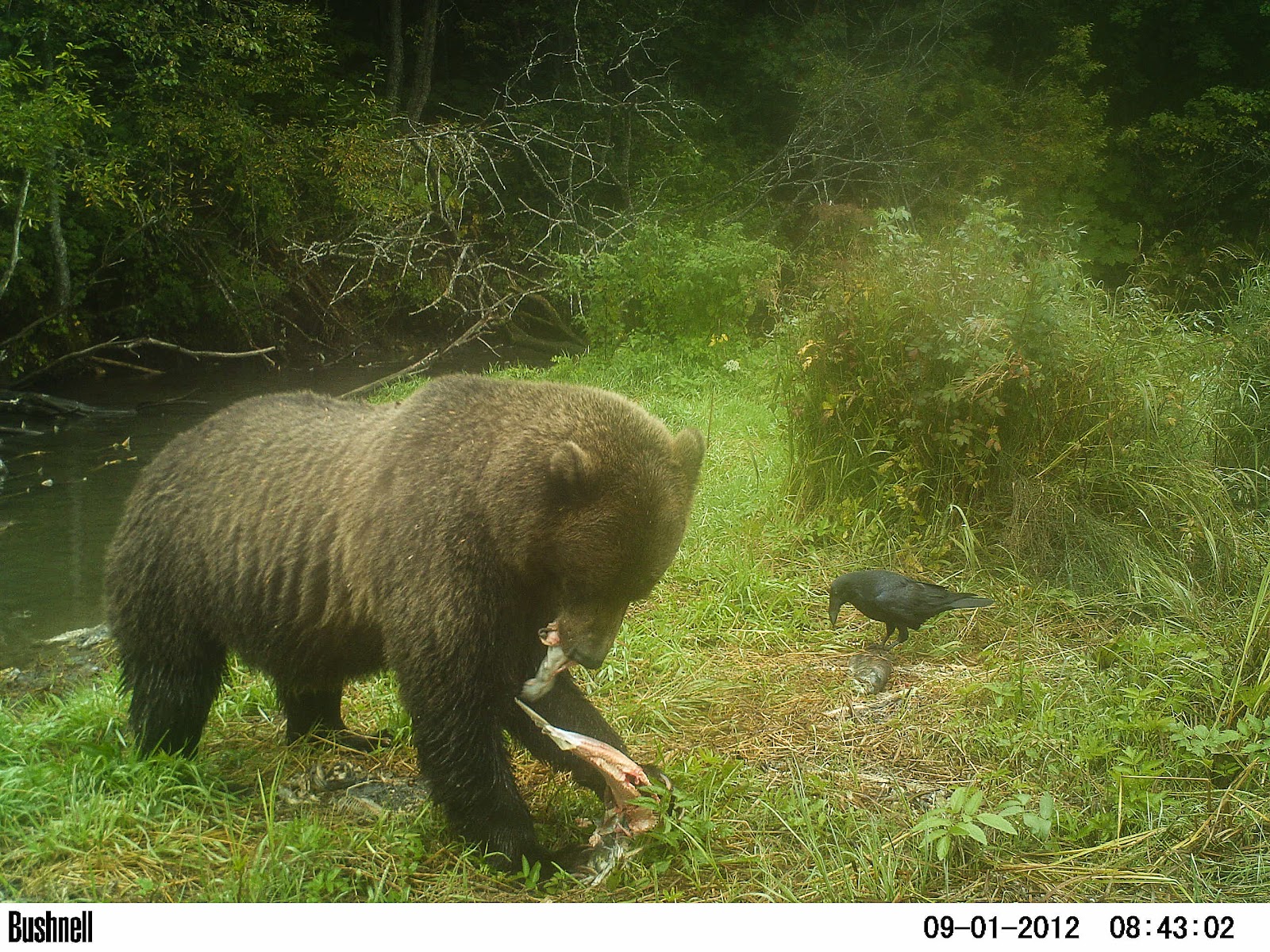
Remember in an earlier post when we discussed high-grading? That's when animals focus on only the highest-grade feed available, ignoring the rest. That's what this bear is doing here: high-grading the sockeye by eating only the skin. The raven is waiting around for the scraps, and won't be disappointed. This bear will leave the remainder of the sockeye carcass, muscle tissue and all, behind and go off to search for more fish brains, roe, and skin, leaving the rest to the scavengers.
This is one of the few photos we've taken of a mustelid (member of the weasel family) in daylight. Not a bad little profile, eh? (As with all the images on our blog, you can click on them to see a larger size.)

These two young bears, probably male siblings, have shown up in several of our trail cameras. Brown bear cubs remain with their mother for two to four years, but don't become sexually mature until they are several years older. Males, in particular, must often wait until they are large and powerful enough to compete with other large males for mates. A large male bear can easily kill a young male, which is why its still safest for these two to stick together.

Raven in-flight! Just a neat little image I thought I'd share.

The final image in this post was actually captured a couple weeks ago, but at the time, we were unable to check the photos on the camera-- we walked up on another camera nearby and found that a bear had been feeding there just a few minutes prior to our arrival. Look at the timestamps (in the lower right-hand corner) on these two images:


Fewer than six minutes elapsed before the bear completely disappeared from the field of view of the camera and the first image the camera took of us walking up to the area. With no way of knowing which direction the bear had gone, we decided it was best to leave without checking the last camera that week. Better to risk losing some images than walking back in brushy area on a wary bear.
For that reason, we missed this photo last week. Remember the image of the wolf from the last set of trail camera photos I posted? Turns out it (or another member of the same pack) had visited another one of our cameras in the area a few days earlier. This time, we were lucky enough to capture a much clearer image.

Labels: Alaska, bears, biology, camera, carnivores, ecology, Haines, Jenn, nature, photography, Quark, Rachel, Rigby, salmon, Trail Cameras, wildlife, wolves
posted by Rachel @ 8:00 AM
1 Comments


