Wednesday, October 24, 2012

More Trail Camera Photos!

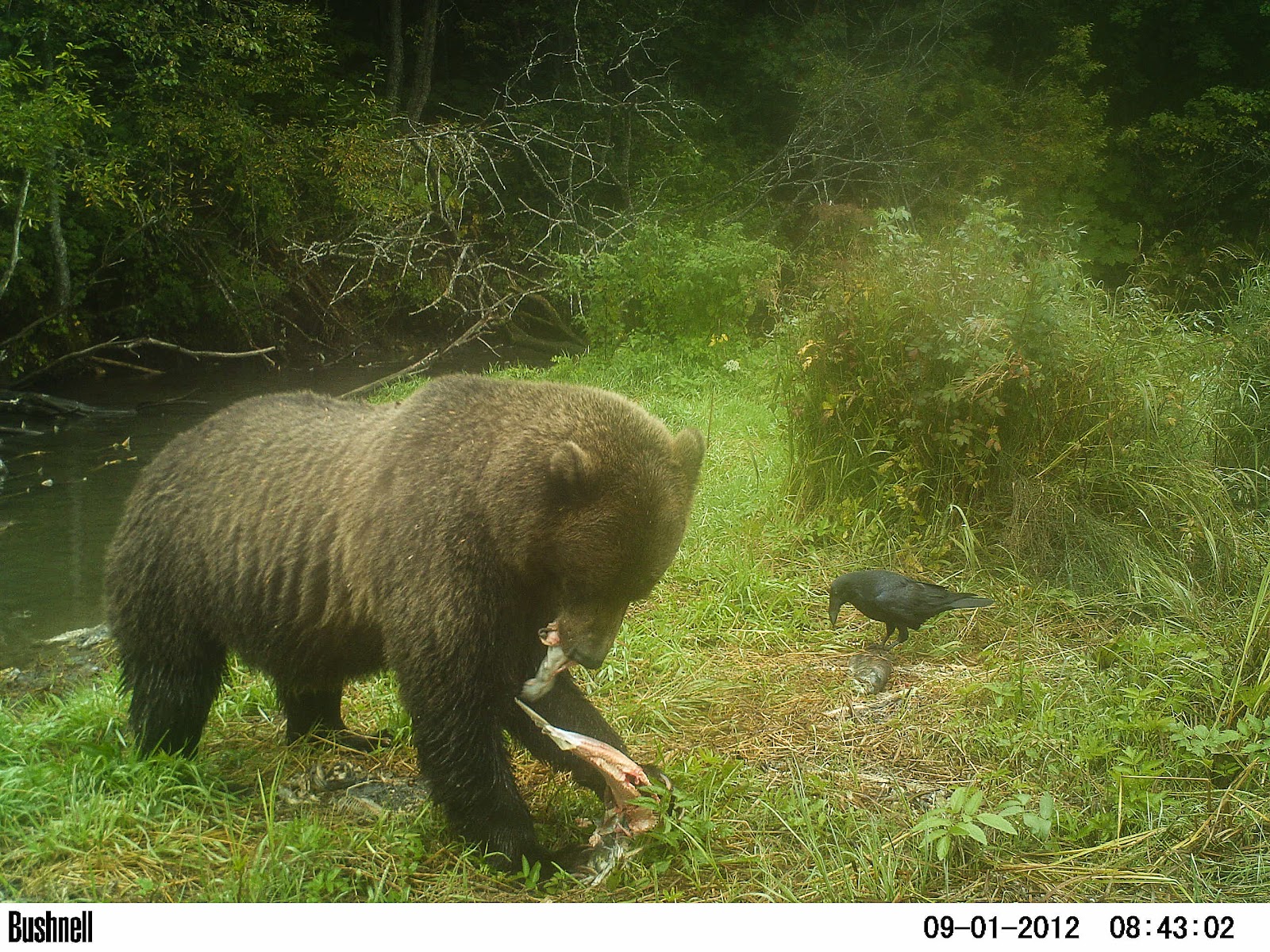
This latest series of trail camera photos comes to you courtesy of the Herman Creek Chum salmon run. Coho and Chum are pretty much the only salmon running this time of year. Coho are a little harder to come by, so anything that's eating salmon is probably going to be eating Chum.

Like these bears:


Or these. How many bears do you see in this photo?


Did you count four? There are the two obvious ones, then part of a third on the right edge of the frame, and part of a sneaky fourth behind the branches along the left edge of the frame.

Here is a less sneaky adult eagle:


and some mergansers and a raven at that same site:


We had a couple coyotes in this set. Here's one of them:


Eagle party! More eagles have been arriving every day. There is a citizen science group in Haines that does weekly eagle counts. Last weekend the tally was 775. It won't be too much longer before there are thousands.


Take a look at this handsome youngster:


We also have some ravens fighting over scraps.


Another photo of a wolf!


And our first moose photo! Well, sort of, anyway.


This last one is tricky. Along the bottom part of the frame in the middle, there is another "first" camera sighting. A rodent! It's impossible to identify the species, or get much beyond "rodent-like small animal." But there it is! Maybe not quite as grand as the brown bears, wolves, and eagles, but I think it's fun to see them just the same.


Labels: , , , , , , , , , , , , , , ,

Thursday, September 27, 2012

Trail Camera Photos!

These are some of the last of the photos from the cameras we set on the Sockeye runs. Since the Sockeye are tapering off and the run is at its end, there are fewer fish, fewer carcasses, and thus fewer animals coming to visit our cameras. Nevertheless, I found a few photos from our final set of Sockeye cameras worth sharing:

Hey look! A marten! In daylight! Almost all of the marten (and mink) photos we get are at night, with the infrared flash. It's really nice to see them in color.


Crow party!


Here's a new one: This is a varied thrush. Varied thrushes are more or less all over the place out here. They are striking birds, with a very distinct grey and orange pattern accented with black and white. They have little interest in our carcasses, but like all thrushes often feed on the ground. You've probably all seen a thrush before-- American Robin are in the thrush family.


Yet another bear photo. We saw very few bears in this last set of images. Most of the photos of were us (setting the cameras) and of mink and marten, with the occasional red squirrel or thrush thrown in the mix. But we did see a couple of bears, this being one of them.


Aaaaaaaaand another wolf photo! I'm very pleased to be seeing wolves in different areas around Haines. The first two photos of wolves I posted were from an area near the confluence of the Kelsall and Chilkat Rivers. This photo was taken near Chilkoot Lake. This appears to be a fairly young animal.
 

Wolves have a tough time living around Haines. There are no deer or elk here. The only large game for packs to hunt is moose, and most of the available moose habitat is much farther up the Chilkat and Chilkoot Rivers and up at higher elevations. Moose are hunted here, and although the moose population is managed to sustain hunting, it is not managed to sustain wolf packs. There is also a lengthy wolf hunting season-- nearly year-round, with a three-month hiatus during summer-- with a limit of five animals. Dedicated wolf hunters could easily disrupt an entire pack.

Many people in the United States are still strong advocates of predator control, and would prefer that wolves aren't around. Some of this is anti-wolf sentiment is interest-based (many game hunters believe that wolves kill a lot of the available prey in an area, meaning fewer animals available for harvest in the fall). Some is likely symbolic (wolves have been portrayed for centuries as something to be feared and destroyed).

Whatever the case, I'm happy to be seeing wolves on our trail cameras. Wolves help sustain healthy populations of their prey, which in turn impacts the vegetation on which herbivores feed. Wolves are often called keystone species-- species which have a disproportionally large impact on their environment, and whose presence helps to balance food webs. A large part of our research involves better understanding the impacts large carnivores, like bears and wolves, have on the environment, and why they are important.

Labels: , , , , , , , , , , , , , , , ,

Sunday, September 16, 2012

Another batch of trail camera photos

Who doesn't like looking at these awesome photographs of Alaskan wildlife? Our third week of camera trapping has come and gone. Check out this set of photos we've captured over the last couple weeks:

Coyote! The first one we've seen on our trail cameras this year, but coyotes are everywhere around this area. Why? Well, for one thing, there aren't many wolves here. Wolf packs usually keep coyote densities low. Without wolves, coyote populations explode.


Remember in an earlier post when we discussed high-grading? That's when animals focus on only the highest-grade feed available, ignoring the rest. That's what this bear is doing here: high-grading the sockeye by eating only the skin. The raven is waiting around for the scraps, and won't be disappointed. This bear will leave the remainder of the sockeye carcass, muscle tissue and all, behind and go off to search for more fish brains, roe, and skin, leaving the rest to the scavengers.


This is one of the few photos we've taken of a mustelid (member of the weasel family) in daylight. Not a bad little profile, eh? (As with all the images on our blog, you can click on them to see a larger size.)


These two young bears, probably male siblings, have shown up in several of our trail cameras. Brown bear cubs remain with their mother for two to four years, but don't become sexually mature until they are several years older. Males, in particular, must often wait until they are large and powerful enough to compete with other large males for mates. A large male bear can easily kill a young male, which is why its still safest for these two to stick together.


Raven in-flight! Just a neat little image I thought I'd share.
 

The final image in this post was actually captured a couple weeks ago, but at the time, we were unable to check the photos on the camera-- we walked up on another camera nearby and found that a bear had been feeding there just a few minutes prior to our arrival. Look at the timestamps (in the lower right-hand corner) on these two images:


Fewer than six minutes elapsed before the bear completely disappeared from the field of view of the camera and the first image the camera took of us walking up to the area. With no way of knowing which direction the bear had gone, we decided it was best to leave without checking the last camera that week. Better to risk losing some images than walking back in brushy area on a wary bear.

For that reason, we missed this photo last week. Remember the image of the wolf from the last set of trail camera photos I posted? Turns out it (or another member of the same pack) had visited another one of our cameras in the area a few days earlier. This time, we were lucky enough to capture a much clearer image.


Labels: , , , , , , , , , , , , , , , ,

<data:blog.pageTitle/>

This Page

has moved to a new address:

http://www.ecologyalaska.com

Sorry for the inconvenience…

Redirection provided by Blogger to WordPress Migration Service