Thursday, September 27, 2012

Trail Camera Photos!

These are some of the last of the photos from the cameras we set on the Sockeye runs. Since the Sockeye are tapering off and the run is at its end, there are fewer fish, fewer carcasses, and thus fewer animals coming to visit our cameras. Nevertheless, I found a few photos from our final set of Sockeye cameras worth sharing:

Hey look! A marten! In daylight! Almost all of the marten (and mink) photos we get are at night, with the infrared flash. It's really nice to see them in color.


Crow party!


Here's a new one: This is a varied thrush. Varied thrushes are more or less all over the place out here. They are striking birds, with a very distinct grey and orange pattern accented with black and white. They have little interest in our carcasses, but like all thrushes often feed on the ground. You've probably all seen a thrush before-- American Robin are in the thrush family.


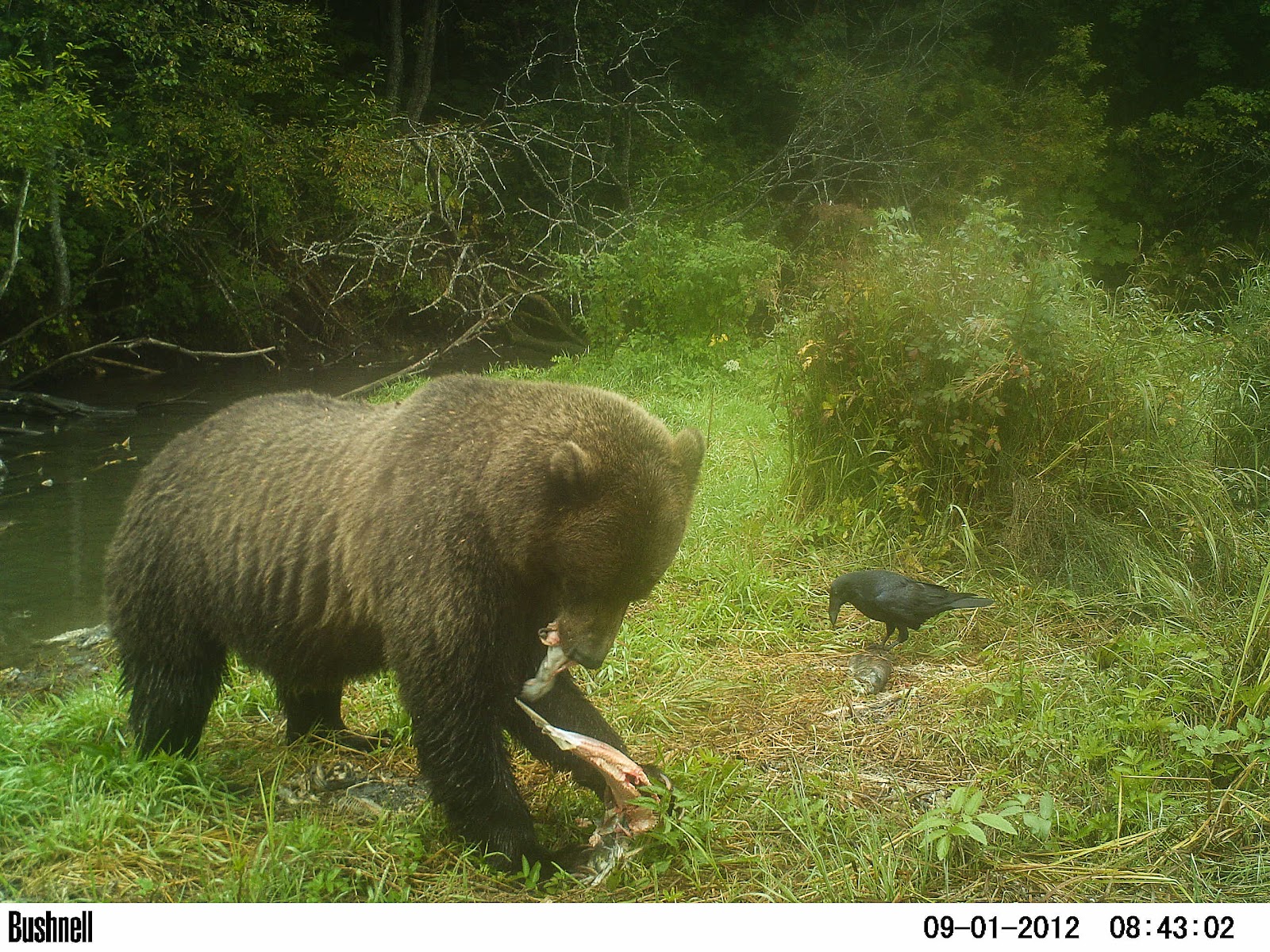
Yet another bear photo. We saw very few bears in this last set of images. Most of the photos of were us (setting the cameras) and of mink and marten, with the occasional red squirrel or thrush thrown in the mix. But we did see a couple of bears, this being one of them.


Aaaaaaaaand another wolf photo! I'm very pleased to be seeing wolves in different areas around Haines. The first two photos of wolves I posted were from an area near the confluence of the Kelsall and Chilkat Rivers. This photo was taken near Chilkoot Lake. This appears to be a fairly young animal.
 

Wolves have a tough time living around Haines. There are no deer or elk here. The only large game for packs to hunt is moose, and most of the available moose habitat is much farther up the Chilkat and Chilkoot Rivers and up at higher elevations. Moose are hunted here, and although the moose population is managed to sustain hunting, it is not managed to sustain wolf packs. There is also a lengthy wolf hunting season-- nearly year-round, with a three-month hiatus during summer-- with a limit of five animals. Dedicated wolf hunters could easily disrupt an entire pack.

Many people in the United States are still strong advocates of predator control, and would prefer that wolves aren't around. Some of this is anti-wolf sentiment is interest-based (many game hunters believe that wolves kill a lot of the available prey in an area, meaning fewer animals available for harvest in the fall). Some is likely symbolic (wolves have been portrayed for centuries as something to be feared and destroyed).

Whatever the case, I'm happy to be seeing wolves on our trail cameras. Wolves help sustain healthy populations of their prey, which in turn impacts the vegetation on which herbivores feed. Wolves are often called keystone species-- species which have a disproportionally large impact on their environment, and whose presence helps to balance food webs. A large part of our research involves better understanding the impacts large carnivores, like bears and wolves, have on the environment, and why they are important.

Labels: , , , , , , , , , , , , , , , ,

Monday, September 24, 2012

Autumn

This past Saturday, the 22nd, was the official first day of autumn. Having grown up in Colorado, autumn has long been my favorite season. Autumn days in the Rockies are mild, sunny, and warm, a wonderful relief from the blisteringly hot days of summer. Nights are crisp and cool. And the colors! Aspen, cottonwood, willow, and maple turning stunning shades of yellow. I missed autumn a lot when I moved to California.

Fall weather in northern California is nice, too. Sunny, not as much fog in the mornings, and warm. But most deciduous trees there keep their leaves year-round, the evenings aren't cool, and there is no nip in the air that suggests impending snow. It's just doesn't feel right. :\

Luckily for me, Alaskan autumns are a lot like Colorado (except with more clouds, humidity, and rain). Gorgeous colors, blankets of yellow, orange, and the occasional red, have spread across the landscape these past few weeks. Temperatures have dropped. Some afternoons, when the breeze is right, you can stand in a shower of gold as leaves falling from trees catch the pale sunlight.

I love autumn.

The eagles are arriving! Each day more and more eagles appear along the Chilkat, staked out on the river flats to feed on the first of the Chum. What makes for a better photograph than golden cottonwood leaves, blue mountains, and an eagle?


For a couple weeks, the weather here was overcast and rainy almost every day. We literally did not see the sun shine for ten days or more. A bit depressing, and a sure sign of the winter to come. Luckily, late September has been kind to us, and we've hit a string of wonderfully sunny days. It's nice to see some blue sky again!


Before the snow travels low enough in altitude to make mountain travel tricky, we decided to make one last trip up to the alpine tundra. Here is a view of the Klehini River from Flower Mountain. Autumn colors make their way into the highest reaches here-- just look at those deep reds of the low-growing plants. Tundra soils are thin (four inches or less in some places), but vegetation still manages to take hold. Alpine berries, willow, lichens, and scraggly, stunted spruce make their homes here, providing food for mountain goats, moose, songbirds, and alpine ground squirrels.

Quite a view, eh?


With a string of sunny days, we've also been making good use of the raft. Rafting down the Klehini affords us opportunities to set trail cameras south and west of the Chilkat, where we see evidence in tracks of moose, wolves, and the ever-present bear. There are plenty of eagles on the Klehini as well!


Mountains, river, blue sky, and birch, cottonwood, alder, and willow changing colors? Alaska, you are wonderful.


And eagles! More and more eagles! The yellow background of these cottonwood leaves may be a bit distracting in this photo, but the colors sure do make it stand out.


Alaska isn't the only pretty place this time of year. Canada has its fair share of gorgeous locales, too. How about this view of Dezadeash Lake, in the Yukon Territory?


Or this lovely little trail, on the route back from St. Elias Lake in Kluane National Park?


Not enough autumn for you? Oh, all right. Here's one last picture: The Tatshenshini Valley.


Be honest now-- who's in the mood for pumpkins, cider, sweaters, or a bit of Halloween fun? Butternut squash ravioli? Homemade applesauce? Pumpkin-spice latte?

Or how about, for those of you lucky enough to live in places where there's an actual autumn, a bit of time spent outdoors enjoying the leaves.

Labels: , , , , , , , , , ,

Sunday, September 16, 2012

Another batch of trail camera photos

Who doesn't like looking at these awesome photographs of Alaskan wildlife? Our third week of camera trapping has come and gone. Check out this set of photos we've captured over the last couple weeks:

Coyote! The first one we've seen on our trail cameras this year, but coyotes are everywhere around this area. Why? Well, for one thing, there aren't many wolves here. Wolf packs usually keep coyote densities low. Without wolves, coyote populations explode.


Remember in an earlier post when we discussed high-grading? That's when animals focus on only the highest-grade feed available, ignoring the rest. That's what this bear is doing here: high-grading the sockeye by eating only the skin. The raven is waiting around for the scraps, and won't be disappointed. This bear will leave the remainder of the sockeye carcass, muscle tissue and all, behind and go off to search for more fish brains, roe, and skin, leaving the rest to the scavengers.


This is one of the few photos we've taken of a mustelid (member of the weasel family) in daylight. Not a bad little profile, eh? (As with all the images on our blog, you can click on them to see a larger size.)


These two young bears, probably male siblings, have shown up in several of our trail cameras. Brown bear cubs remain with their mother for two to four years, but don't become sexually mature until they are several years older. Males, in particular, must often wait until they are large and powerful enough to compete with other large males for mates. A large male bear can easily kill a young male, which is why its still safest for these two to stick together.


Raven in-flight! Just a neat little image I thought I'd share.
 

The final image in this post was actually captured a couple weeks ago, but at the time, we were unable to check the photos on the camera-- we walked up on another camera nearby and found that a bear had been feeding there just a few minutes prior to our arrival. Look at the timestamps (in the lower right-hand corner) on these two images:


Fewer than six minutes elapsed before the bear completely disappeared from the field of view of the camera and the first image the camera took of us walking up to the area. With no way of knowing which direction the bear had gone, we decided it was best to leave without checking the last camera that week. Better to risk losing some images than walking back in brushy area on a wary bear.

For that reason, we missed this photo last week. Remember the image of the wolf from the last set of trail camera photos I posted? Turns out it (or another member of the same pack) had visited another one of our cameras in the area a few days earlier. This time, we were lucky enough to capture a much clearer image.


Labels: , , , , , , , , , , , , , , , ,

Wednesday, September 12, 2012

Trivia Question of the Week

This week's Trivia Question comes to you from our trail cameras! It's a little tougher this week:

What type of animal was captured in this photograph?

(You can click the image to view a larger version)

Hint #1: This photo was taken with an infrared flash at night, so colors won't be there to help you.

Hint #2: The animal in question is in the bottom left-hand part of the frame.

Hint #3: It may seem obvious to some, but it's worth pointing out: this animal is nocturnal.

Hint #4: It's facing away from the camera-- what we're seeing here is, predominately, its back.

Hint #5: This animal is a bird of prey.

.
.
.
.
.
.
.
.
.
.

Did you guess Great Horned Owl? If you did, congratulations! Want to helps us identify some other animals?

One of the trickiest aspects of using trail cameras is that the photographs we capture aren't always straightforward. Animals sometimes move quickly across the frame, and the shutter speed of the cameras won't be high enough to prevent motion blur. Sometimes, animals get too close to the cameras and the flash reflects back into the lens, causing white-out or blown highlights. Some animals will be hovering around the edges of the camera's field of view, and only parts of them- tails, feet, the curve of their rump- might end up being captured. Photos taken at night can be particularly difficult because there are no colors. As humans, we rely on colors and color patterns to identify a lot of different animal species-- tough to do when everything is showing in gray-scale!

Did you have difficulty identifying the owl in this photograph? You're not alone. Correctly identifying the species in trail camera photographs is critical for later data analysis, so it can be time consuming and trying to sort through hundreds of photos and pick out the different types of animals in each. Sometimes we find images we really can't identify. With those, we have to do our best to determine the animal's family, at the very least. Is it a mustelid (member of the weasel family, like a mink, marten, ermine, otter, etc.)? Canid (coyote, wolf, fox)? Ursid (brown bear, black bear)?

We also rely a great deal on natural history (knowledge of the animals living in an area and their habits) and contextual cues. For example, wolves aren't likely to be seen close to town, so an shaky image of something dog-like is probably a coyote or domestic dog. River otters won't be found far from water, so an image of a large weasel-like animal captured with a camera on a high altitude trail a mile away from the nearest stream is probably a marten. If one set of photographs is blurry, but there is a photo taken a couple minutes before or afterward of a mink, the blurry photos are probably also mink-- it's uncommon to capture photographs of two completely different animals within a few minutes of one another, unless they're, say, different types of birds feeding along a spawning area.

Here are a few other tricky photos for you to try out:


See the hump in the bottom part of the frame? Any guesses? This one is probably a marten.


In the lower part of the frame, just to the left of center, see the lighter-colored animal against the dark background? This is likely a mink.


See the weasel-like animal just below and left of the center of the photo? This one is probably a mink, too.

If you enjoyed looking at these photos and trying to figure out what you're seeing, you might be able to participate directly in projects like ours in the near future. Yiwei is currently working on developing an interactive game for Facebook that will allow users to work in teams to help tag photos just like these.

Labels: , , , , , , , , , , , , ,

Thursday, August 30, 2012

First Trail Camera Photos!

Take a look at what we've been seeing with our trail cameras! As to be expected, there is a lot of bear activity this time of year. But at the cameras we're setting a short distance away from the river, we're seeing some smaller carnivores, too!

Bear! Look at that fish!


 Look who's checking out the salmon carcass!
  

Hey bear!


 Stretch those wings, eagle!


Success!


 Do you think it sees the camera?


 Cub! And mama, of course.


Yes! A rotting fish carcass! Oh, wait.... 


Labels: , , , , , , , , , ,

Tuesday, August 28, 2012

Sockeye

Sockeye salmon (Oncorhynchus nerka) are one of the more desirable species of salmon in Alaska. Sockeye tend to have rich, fatty meat, and their muscle ranges from pink to deep red in color, making it the preferred fish of canneries. In this region, most people that eat fish think King is king-- King salmon have the best flavor of them all-- but Sockeye probably comes a close second.

Sockeye are, in my opinion, the prettiest of the bunch when they're breeding. Males and females both take on a deep red hue, with green heads and tails. They only develop this color scheme when they're spawning. When living in the ocean, and before they begin to spawn, Sockeye are silvery blue. Check out this video of Sockeye on their spawning grounds in Chilkoot Lake:


Remember that Sockeye (like all the salmon we study) are anadromous fishes. Anadromous comes from the Greek word anadromos, meaning "running upward." Anadromous fish spend most of their lives at sea before migrating to freshwater streams and running upriver to breed and die. Most Sockeye spawn between July and August, so we're just seeing the tail end of the Sockeye run around Haines.

Imagine seeing hundreds of fish swimming together in a narrow stream bed or shallow pond just off of a major river:


The setting seems idyllic. Tree boughs overhang the creek, providing shade. The rocky bottom, interspersed with sandy patches, is a great place for a female Sockeye to build a redd (nest), lay her eggs, and attract a male to fertilize her brood. In the spring, her eggs will hatch, and the fry (young fish) will spend up to three years living in this stream, growing, before migrating out to sea*.

But before too long, the strain of migrating anywhere from hundreds to thousands of kilometers, breeding, defending territories and redds, and chasing off competing fish, all without eating, begins to take its toll. During spawning, salmon put all of their energy into breeding. All the normal things that we do on a day-to-day basis to stay alive (eating, for example), and all the things our bodies do to keep us healthy (fight off infections, destroy damaged cells, etc.) salmon neglect in favor of procreation. In fact, by the time salmon reach their spawning grounds, they've already begun the descent to senescence. The salmon start rotting before they've even died.


Can you see this white patches on these salmon? Those are parts of their skin that have died and begun to decompose. Some salmon appear in relatively good condition before they die; others are heavily mottled with patches of decaying flesh. In a short period of time, the idyllic creek filled with spawning fish turns into a apocalyptic wasteland of decomposing salmon carcasses. Bears get to many of them:


Others are left in the stream to decay:


Just one week ago, Jenn and I set our trail cameras in this area and recorded the video of the peaceful stream above. When we returned, seven days later, to check the cameras, we walked into a wasteland of salmon carcasses. What a difference a single week makes! Very quickly the salmon in these areas are finishing their breeding cycle and dying off. It may seem unpleasant (and in fact they do smell terrible) but it is endlessly fascinating. The carcasses these decomposing salmon leave behind will provide valuable nutrients, like nitrogen and phosphorus, to both the stream bed and surrounding terrestrial vegetation. And, of course, they also provide plenty of food for the carnivores!


*Not all salmon species spend extended periods of time as frys in freshwater areas before migrating to sea. Some species spend more time (upwards of four years for some Sockeye), and others, less. Chum salmon, for example, are born in freshwater streams and migrate to sea immediately.

Labels: , , , , , , , , , , ,

Friday, July 13, 2012

Equipment (Part 1 of ?)

The countdown is on! I (Rachel) am leaving to head up to Haines, Alaska, in less than a week! As part of my pre-trip preparations, I've been getting our equipment assembled.

A large part of our research project involves the use of noninvasive motion-detecting trail cameras to census wildlife populations. We set these cameras up on trees, or sometimes fence posts or t-posts, and program them to take an image of anything that might wander by, day or night. This allows us to see what species of wildlife are around, and the frequency each species might use a specific area. For example, cameras set near popular hiking trails see a lot of human activity during the day-- bikers, hikers, horseback riders, and people walking their pets. During nighttime, however, the same trails are often used by wildlife species. Check out some of the photos Yiwei's trail cameras have captured of wildlife around the Santa Cruz Mountains!

Each trail camera set-up has several parts, pictured here. The main body of the camera, housed in brown plastic, has a motion sensor and infrared flash. The camera itself sits in a protective steel casing, which will (hopefully) prevent curious bears from destroying it. The entire unit is secured to a tree or other object with a nylon strap, and is protected from theft by a strong cable lock.


The cameras we use are Bushnell Trophy Cam. These cameras are digital, take AA batteries, and use SD cards.  They are easy to set up and use, and pictures can be downloaded directly to a personal computer. For those of you that live in rural areas, or who live in areas bordering open space, like fields or forests, you can purchase and use your own trail camera right in your own backyard! The camera units, sans bear-proof steel housing, run around $200 a piece, and with lithium batteries and a large SD card can be left in the field for months at a time (of course, you can always check them more frequently if you want). If you're curious to see what types of wildlife live around your home, consider setting up your own trail camera!

This week I inventoried all of our trail cameras for our upcoming Alaska predator project. All of our cameras are numbered, and since theft and curious passers-by are always a possibility, even in remote areas, we add contact information to each unit. Here are the cameras, locks, and SD cards, all set and ready to go!


Before too long we'll have these cameras set up in Alaska, and will have Alaskan wildlife pictures to share!

Labels: , , , ,

Friday, May 18, 2012

Who are we? (Part 3)

Hey there! My name is Rachel Wheat. I grew up on the front range of the Rocky Mountains in Colorado, and have long been fascinated with wildlife and the natural world. I've worked on a variety of field projects, from researching tree squirrels in Colorado to sage-grouse in Wyoming to gray wolves in Yellowstone National Park. Needless to say, I'm thrilled to be starting this newest research project to study salmon-wildlife interactions near Haines, Alaska!
Read more »

Labels: , , , , , ,

<data:blog.pageTitle/>

This Page

has moved to a new address:

http://www.ecologyalaska.com

Sorry for the inconvenience…

Redirection provided by Blogger to WordPress Migration Service