Monday, January 21, 2013

Trivia Question of the Week

We learned last week that Pacific salmon can grow to very large sizes when they spawn, but how do they know where to spawn?

If Pacific salmon spend most of their lives in the open ocean, how do they find their natal streams (the streams in which they were born) when they return to freshwater to spawn?

Hint #1: Planetarium studies have indicated that some species of bird rely on celestial navigation, orienting themselves based on the location of specific starts in the night sky. But since salmon can't see the stars, this isn't a tactic they can utilize.

Hint #2: Birds and salmon do have a navigation technique in common, though. It's the same way many animal species, from bats to sea turtles, find their way.

Hint #3: Scientists believe that salmon use not one, but two navigational aids to return from the ocean to their natal streams.

Hint #4: The technique for traversing ocean currents to find their way to freshwater is thought to be different from the method salmon rely on in the streams themselves.

Hint #5: You may think Fido is good at sniffing things out, but he can't compare to a Pacific salmon.

.
.
.
.
.
.
.
.
.
.
Photo credit: Natalie Fobes

The two primary navigational aids salmon rely on are magnetism and scent. When salmon are in the open ocean, scientists believe they travel primarily by orienting themselves with the earth's magnetic field, much like many migrating species, like sea turtles, birds, and bats. Once they reach freshwater, however, scent plays the dominant role in guiding salmon travel. Young salmon migrating out to sea, known as smolts (pictured above), imprint different scents from their environment as they travel downstream. This allows them to create a memory bank of scents, which they later can use as a scent-map of sorts to guide their return to their birthplace as adults.

Labels: , , , , ,

Thursday, January 17, 2013

Eagle Update

The past couple weeks have seen few changes in the places our GPS tagged eagles have been traveling. The females are still seemingly content to stay on the Chilkat, while the males are still southward in and around Prince Rupert.

The adult female, 3E, and the immature female, 4P, are both right around the area we initially caught them:

3E


4P


The mature male, 3C, is still moving around a bit, bouncing eastward, then westward again, then a bit to the southeast, though he is still near Prince Rupert. You can see pretty clearly on this image how he has been following waterways closely as he travels.

3C


The immature male, 2Z, has now been in Prince Rupert for more than a month. This may be where he stays until spring. It seems 2Z is spending time feeding at a landfill near the city. Since he is a younger bird, he may not be able to compete with other eagles for better food sources (e.g. fish), or perhaps his hunting skills aren't quite up to scratch. Whatever the reason, doesn't appear to be following the salmon, but rather, the dump truck.

2Z


In the upper right hand corner of the photo above, you can see a little portion of 3C's track, where the two birds were near one another for a short time.

Labels: , , , , , , , ,

Thursday, December 20, 2012

Feast

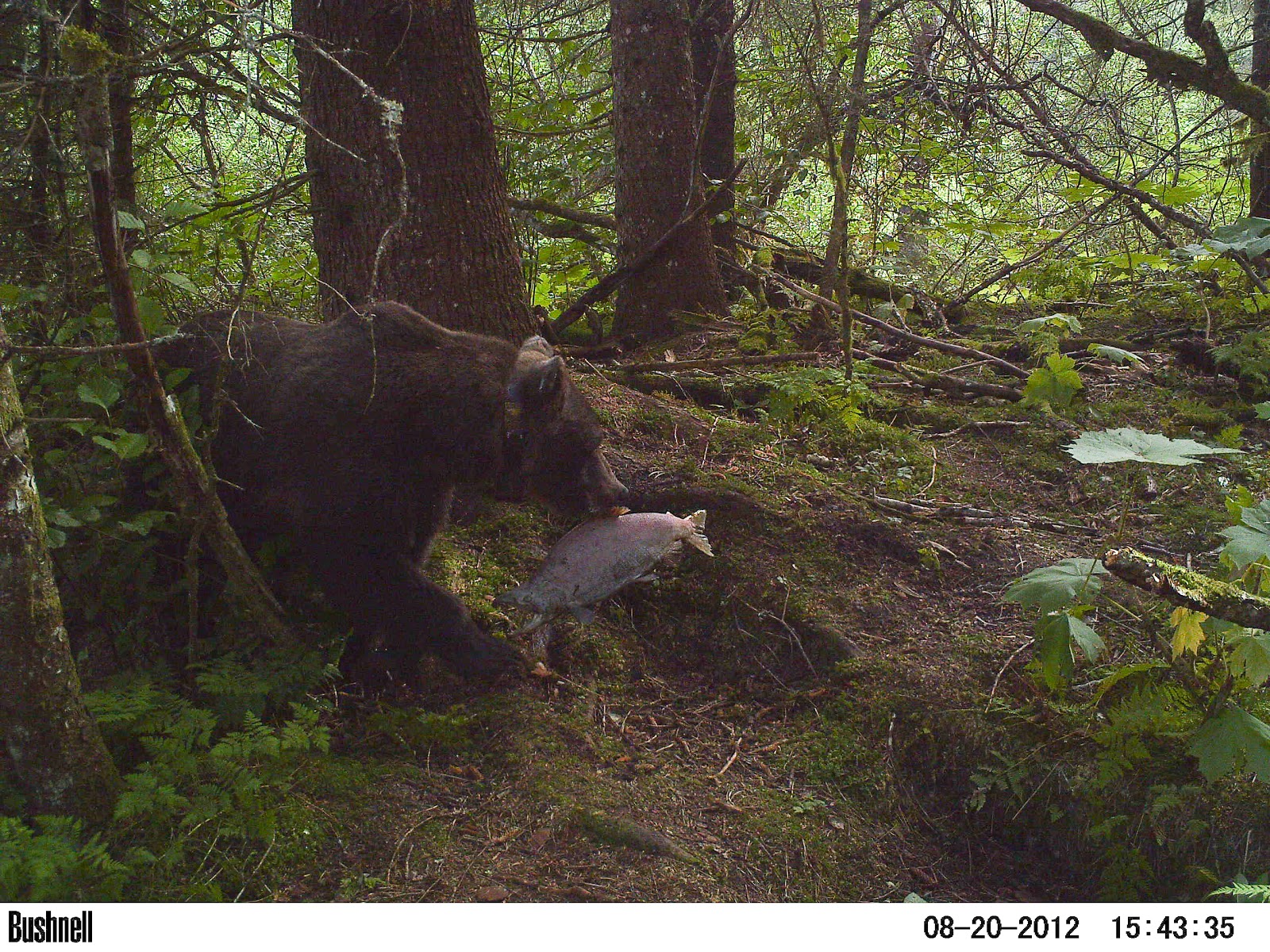
I've been sifting through our trail camera photos, trying to pick out the best ones to share, as well as identify those that detail animal behavior. We captured a few interesting events-- bears rubbing on trees and chasing after fish in the stream, flocks of crows appearing and disappearing just as quickly-- but since we're right in the middle of the holiday season, it seemed fitting to talk about feasts! When salmon are plentiful, bears will high-grade salmon, eating only the energy rich, fatty parts of the fish: the skin, roe, and brains. When salmon decrease in numbers, however, a bear will make good work of a salmon carcass, eating everything it can.

Read more »

Labels: , , , , , ,

Monday, December 10, 2012

4N

Rigby and I are back in Santa Cruz, adjusting to things we haven't seen in a while-- stoplights, traffic, and sunshine, just to name a few. We've finally managed to get internet up and running in our new place, so it's back to blogging!

Today's entry focuses on one of the more frustrating aspects of working with wild animals: data loss. So far, we've been getting pretty reliable information from the GPS tags on our eagles, but the data are not without problems. Since the tags are solar powered, they need to have reliable sunshine to keep the battery charged and the device functioning. In southeast Alaska, where snow is a daily occurrence and daylight hours are rapidly diminishing, it's tough for the tags to get the juice they need. This is complicated by the fact that the Chilkat River is surrounded on both sides by relatively steep mountain ranges. Even when the sun does come out, much of the river is still in shadow.

Read more »

Labels: , , , , , , , , ,

Wednesday, November 28, 2012

Trivia Question of the Week, and what's up next

This week's trivia question is paired with statistics for this season's fieldwork. What is the animal we saw most frequently on our trail cameras this summer?

Hint #1: This contest was pretty close, with a couple hundred pictures or so separating the first and second most frequently sighted animals.

Hint #2: In broad terms, the second most frequently sighted type of animal actually beats out the first, but in terms of species, there is one clear winner.

Hint #3: Their name starts with "B"

Hint #4: They're furry

Hint #5: If you anger them, they'll eat your face off. :)

.
.
.
.
.
.
.
.
.
.


If you guessed Brown Bear, you're correct! You've obviously been following along with us this season. Or you know that bears will eat your face off. Either way, congratulations!

"Bears" as a broad category, was actually beat out by "birds"-- we saw more birds overall on our trail cameras than bears. Whereas the "bird" category is composed of eagles, raven, magpies, crows, mergansers, blue-winged teals, varied thrushes, and others, however, the "bears" category is all brown bears. We didn't see a single black bear on our trail cameras this season.

For our trail camera work this summer and fall, we captured:
  • 24,767 photographs, total
  • 6,605 images of bears
  • 7,841 photos of birds
  • 71 photos of canids (wolves, coyotes, and domestic dogs)
  • 332 mustelid photos (mink and marten)
  • 59 photos of rodents (mice and red squirrels)
  • 94 photos of humans (not including ourselves)
  • 0 photos of lynx, wolverine, black bear, or lagamorphs (hares or rabbits), although these species all live in the area

Now that I'm headed back to Santa Cruz and our field season is over for the year, you may be wondering what's in store for the blog. Will I keep updating? What can you expect to see?

Well, by my calculations I've shared around 60 of our trail camera photos here on the blog. That means there are an additional 24,707 photos I could post! :)  I'll continue to post trail camera photos from time to time, in addition to videos I'm currently working on putting together that detail sequences of trail camera photographs, like bears or eagles feeding on the salmon carcasses.

And don't forget about our eagles! We'll continue to follow the movements of the five eagles we tagged with GPS/satellite transmitters, and we'll post these locations for you as we go along.

There are several other stories from the field that I haven't yet had time to put together into blog entries that I'm hoping to work in within the next couple of months. We're also working on putting together a fully-fledged website for Ecology Alaska. So among trail camera photos, eagle movement data, stories from our fieldwork in Haines, and perhaps a few entries detailing the life of a wildlife biologist outside of the field season, there should be plenty going on here on the blog. I imagine that the rate of posting will decrease come the beginning of the year, but I will attempt to continue posting at least one entry and one trivia question each week.

Stay tuned, and as always, feel free to let us know what you think, by leaving us a message in the comments or sending us an email at ecologyalaska [at] gmail (dot) com.

Labels: , , , , , , , , ,

Monday, November 26, 2012

Southward Bound

It's hard to believe, but it's been exactly four months since Rigby and I arrived in Haines on the ferry from Prince Rupert. From the Southeastern Alaska State Fair, to hiking Mt. Ripinsky and the trails in Chilkat State Park, to learning about spawning salmon, subsistence fishing and canning, to setting out trail cameras and finally, trapping and tagging bald eagles, the last four months have been filled with a host of new experiences and opportunities. And bears.


Read more »

Labels: , , , , , , , , , , , , , , ,

Saturday, November 24, 2012

Where are they now? (cont.)

The male eagles we tagged, 3C and 2Z, have been busy! Unlike the females, the males have been traveling around a bit more. We suspect this is because males, who are significantly smaller than the females, aren't able to compete as well for food.

3C, the adult male, is still in the Chilkat Valley, although he's been wandering away from the river itself:

Read more »

Labels: , , , , , , ,

Thursday, November 22, 2012

Where are they now?

The great thing about attaching satellite transmitters to our eagles is that the information is fed to us on a regular basis. If the eagles leave the area, we won't have to worry about tracking them by foot or in a plane-- the satellites will download the GPS locations of the birds and we can access the information online. Our transmitters collect a GPS location every hour during daylight, and we receive a list of the locations every two to four days. This means that we're already seeing where our eagles are moving!

Read more »

Labels: , , , , , , , ,

Wednesday, October 24, 2012

More Trail Camera Photos!

This latest series of trail camera photos comes to you courtesy of the Herman Creek Chum salmon run. Coho and Chum are pretty much the only salmon running this time of year. Coho are a little harder to come by, so anything that's eating salmon is probably going to be eating Chum.

Like these bears:


Or these. How many bears do you see in this photo?


Did you count four? There are the two obvious ones, then part of a third on the right edge of the frame, and part of a sneaky fourth behind the branches along the left edge of the frame.

Here is a less sneaky adult eagle:


and some mergansers and a raven at that same site:


We had a couple coyotes in this set. Here's one of them:


Eagle party! More eagles have been arriving every day. There is a citizen science group in Haines that does weekly eagle counts. Last weekend the tally was 775. It won't be too much longer before there are thousands.


Take a look at this handsome youngster:


We also have some ravens fighting over scraps.


Another photo of a wolf!


And our first moose photo! Well, sort of, anyway.


This last one is tricky. Along the bottom part of the frame in the middle, there is another "first" camera sighting. A rodent! It's impossible to identify the species, or get much beyond "rodent-like small animal." But there it is! Maybe not quite as grand as the brown bears, wolves, and eagles, but I think it's fun to see them just the same.


Labels: , , , , , , , , , , , , , , ,

Sunday, October 21, 2012

Trivia Question of the Week

With plenty of eagles here already and more on the way, this week's question is appropriately eagle-themed.

What is the grip strength of an adult bald eagle?

Hint #1: The tendons in bird's legs have tiny ridges on them that interlock with the tendon sheaths when flexed, holding the talons closed without any additional effort on the part of the bird. Ever wonder why birds don't fall off branches while they're sleeping? It's because the tendons in their feet are locked in place.

Hint #2: The largest species of eagle in the world, the Harpy Eagle, has enough grip strength to crush the bones of large mammals.

Hint #3: Bald eagles may not be able to crush large mammal bones, but they can definitely do some damage to a human wrist.

Hint #4: Their grip strength allows them to pull salmon equal to their own weight from the water.

Hint #5: An eagle's grip strength is more than 10 times that of a human hand.

.
.
.
.
.
.
.
.
.
.


If you guessed 400 pounds per square inch (psi), then you are a true ornithology nerd champion and know far more about bald eagles than is healthy anyone else. The grip strength of the average adult human, by comparison, is only about 20 psi.


Labels: , , , , , ,

Thursday, October 18, 2012

Trail Camera Photos: Bear Edition

Hey everyone! Over the past few weeks I've been working hard at sifting through our collection of trail camera photos and tagging them all-- adding digital labels to identify what was recorded in the image. Most weeks we download anywhere from a few hundred to a few thousand photographs off our cameras, so sometimes it takes a while to get through them. We have nearly 15,000 photographs already from this field season, with about five weeks remaining to collect data.

Each photo must be properly tagged with information about the date and location the photo was taken, along with whatever critter(s) may have shown up, in order for us to be able to analyze the data later on. It can be a tedious and time-consuming process, but it's nice to have a searchable database of images. Once tagged, I can easily go back and locate every single photo we have of a marten, a canid, a crow, etc.

So instead of sharing photos from a specific location, this week I decided to share photos of a specific subgroup of subjects: brown bears! We have so many images of bears that it was hard to decide which to share. This is just a sampling of some of the bear pictures we've taken the past couple months:

This was a nice closeup we got at one of our first trapping locations, at the end of August. This is the same place we saw the bear cub and the wolf I posted earlier. This camera had great placement-- just about every photo we got off it was crisp, clear, and in focus.


Here's another earlier image. This is one of two female brown bears that the Alaska Department of Fish and Game monitors-- see her radio collar?

 
This image is more recent, from a set of cameras we have on a run of Chum salmon up Herman Creek.


Another more recent image taken at the same location. This is one of the better nighttime images we have of a brown bear.


Although this one isn't bad, either. But I just realized the clock somehow got reset on this camera, and the time stamp isn't right. Dangit! :\


This bear doesn't look particularly happy to have its photo taken.


Neither does this one. And it has backup!


This bear, however, is pretty fluffy. Not nearly as intimidating.


So many bears!

Labels: , , , , , , , , ,

Thursday, September 27, 2012

Trail Camera Photos!

These are some of the last of the photos from the cameras we set on the Sockeye runs. Since the Sockeye are tapering off and the run is at its end, there are fewer fish, fewer carcasses, and thus fewer animals coming to visit our cameras. Nevertheless, I found a few photos from our final set of Sockeye cameras worth sharing:

Hey look! A marten! In daylight! Almost all of the marten (and mink) photos we get are at night, with the infrared flash. It's really nice to see them in color.


Crow party!


Here's a new one: This is a varied thrush. Varied thrushes are more or less all over the place out here. They are striking birds, with a very distinct grey and orange pattern accented with black and white. They have little interest in our carcasses, but like all thrushes often feed on the ground. You've probably all seen a thrush before-- American Robin are in the thrush family.


Yet another bear photo. We saw very few bears in this last set of images. Most of the photos of were us (setting the cameras) and of mink and marten, with the occasional red squirrel or thrush thrown in the mix. But we did see a couple of bears, this being one of them.


Aaaaaaaaand another wolf photo! I'm very pleased to be seeing wolves in different areas around Haines. The first two photos of wolves I posted were from an area near the confluence of the Kelsall and Chilkat Rivers. This photo was taken near Chilkoot Lake. This appears to be a fairly young animal.
 

Wolves have a tough time living around Haines. There are no deer or elk here. The only large game for packs to hunt is moose, and most of the available moose habitat is much farther up the Chilkat and Chilkoot Rivers and up at higher elevations. Moose are hunted here, and although the moose population is managed to sustain hunting, it is not managed to sustain wolf packs. There is also a lengthy wolf hunting season-- nearly year-round, with a three-month hiatus during summer-- with a limit of five animals. Dedicated wolf hunters could easily disrupt an entire pack.

Many people in the United States are still strong advocates of predator control, and would prefer that wolves aren't around. Some of this is anti-wolf sentiment is interest-based (many game hunters believe that wolves kill a lot of the available prey in an area, meaning fewer animals available for harvest in the fall). Some is likely symbolic (wolves have been portrayed for centuries as something to be feared and destroyed).

Whatever the case, I'm happy to be seeing wolves on our trail cameras. Wolves help sustain healthy populations of their prey, which in turn impacts the vegetation on which herbivores feed. Wolves are often called keystone species-- species which have a disproportionally large impact on their environment, and whose presence helps to balance food webs. A large part of our research involves better understanding the impacts large carnivores, like bears and wolves, have on the environment, and why they are important.

Labels: , , , , , , , , , , , , , , , ,

Sunday, September 16, 2012

Another batch of trail camera photos

Who doesn't like looking at these awesome photographs of Alaskan wildlife? Our third week of camera trapping has come and gone. Check out this set of photos we've captured over the last couple weeks:

Coyote! The first one we've seen on our trail cameras this year, but coyotes are everywhere around this area. Why? Well, for one thing, there aren't many wolves here. Wolf packs usually keep coyote densities low. Without wolves, coyote populations explode.


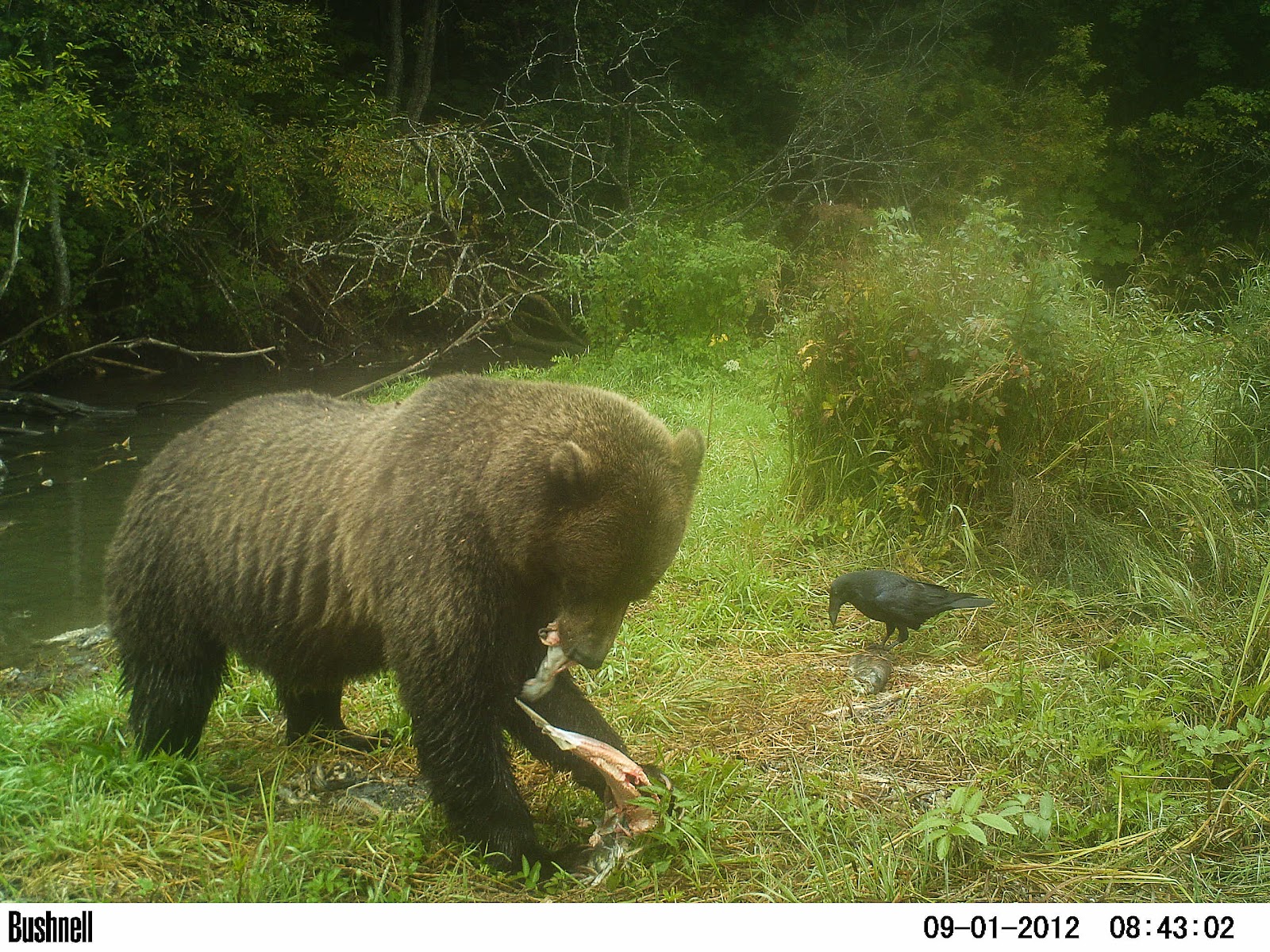
Remember in an earlier post when we discussed high-grading? That's when animals focus on only the highest-grade feed available, ignoring the rest. That's what this bear is doing here: high-grading the sockeye by eating only the skin. The raven is waiting around for the scraps, and won't be disappointed. This bear will leave the remainder of the sockeye carcass, muscle tissue and all, behind and go off to search for more fish brains, roe, and skin, leaving the rest to the scavengers.


This is one of the few photos we've taken of a mustelid (member of the weasel family) in daylight. Not a bad little profile, eh? (As with all the images on our blog, you can click on them to see a larger size.)


These two young bears, probably male siblings, have shown up in several of our trail cameras. Brown bear cubs remain with their mother for two to four years, but don't become sexually mature until they are several years older. Males, in particular, must often wait until they are large and powerful enough to compete with other large males for mates. A large male bear can easily kill a young male, which is why its still safest for these two to stick together.


Raven in-flight! Just a neat little image I thought I'd share.
 

The final image in this post was actually captured a couple weeks ago, but at the time, we were unable to check the photos on the camera-- we walked up on another camera nearby and found that a bear had been feeding there just a few minutes prior to our arrival. Look at the timestamps (in the lower right-hand corner) on these two images:


Fewer than six minutes elapsed before the bear completely disappeared from the field of view of the camera and the first image the camera took of us walking up to the area. With no way of knowing which direction the bear had gone, we decided it was best to leave without checking the last camera that week. Better to risk losing some images than walking back in brushy area on a wary bear.

For that reason, we missed this photo last week. Remember the image of the wolf from the last set of trail camera photos I posted? Turns out it (or another member of the same pack) had visited another one of our cameras in the area a few days earlier. This time, we were lucky enough to capture a much clearer image.


Labels: , , , , , , , , , , , , , , , ,

Thursday, September 13, 2012

The Chum are Coming!

Over the past couple weeks, the Sockeye runs have been slowing down. Most of the Sockeye in the spawning areas have now died, and few new Sockeye appear each day. Carcasses litter the streams, ponds, and banks. We've gradually seen less activity on our trail cameras-- fewer bears are visiting key feeding areas, and we come across fewer partially consumed carcasses along bear trails. But the bears have no need to be concerned. There are plenty of other fish in the stream!

Pink salmon are still running, although their numbers have decreased, too. Coho salmon also continue to spawn, but spawn in much lower densities and across larger areas than Sockeye, so it's more difficult to locate their spawning grounds. The bears' next big target, though (and ours, too, for our trail cameras) are the Chum. Just last week, there were only a few fish in this spawning channel off of Herman Creek. Already, the densities are quickly increasing:


Chum salmon are also called Dog and Keta. Keta is the name typically used by canning companies (after all, who wants to eat "chum" anyway?). Chum and Pink salmon are the least commercially valuable fish. Most commercial fishing and canning operations prefer King and Sockeye, but many subsistence fishers in this region like Chum just fine-- especially when smoked, fresh-caught Chum has good flavor.
Chum salmon spawn in autumn, from roughly the end of August through the winter, or at least until the rivers freeze enough to prevent their travel upstream. Chum spawn by the hundreds of thousands, and much like Sockeye they pack themselves into their spawning areas. Chum can pack themselves in even greater densities than the Sockeye. Sockeye are limited by available fry rearing habitat-- once their eggs hatch the young salmon fry need suitable places to grow for a year or two before migrating to sea. Thus, Sockeye need good places to lay their eggs that are also in areas fit for little fish to grow.

Chum, however, are limited only by spawning habitat. Their fry migrate to sea more or less immediately after hatching. Chum salmon don't need to find suitable places for their fry to grow, only good spots for the eggs to hatch. As long as they can locate nice, rocky substrate with good water flow, they can spawn, so Chum find whatever spawning habitat is available, even if there are already hundreds of other fish around. This makes them easy for wildlife to access. Just walk up to the water and grab one!

With the weather quickly cooling and the Chum beginning to run, the eagles are beginning to congregate. We've started to see far more eagles around Haines recently. Gradually over the next month, the water level of the Chilkat River will drop, exposing the river flats and providing many shallow areas for wildlife to access fish. The Chum run will increase, until the braided areas of the Chilkat are packed with fish. And, as temperatures continue to decrease and freezing begins elsewhere along the coast and in the interior, more and more eagles will travel to Haines to feast on Chum through the beginning of winter.

We will continue to set our trail cameras out to capture wildlife feeding on salmon. At the end of this week, we will take down our last set of trail cameras from the Sockeye runs, and, starting next week, will set our cameras on Chum spawning areas and on higher elevation wildlife trails. Once the eagles begin arriving en mass, we will also start working on the second part of our research here-- looking into eagle migratory behavior!

Labels: , , , , , , , , , , , , , , ,

Wednesday, September 12, 2012

Trivia Question of the Week

This week's Trivia Question comes to you from our trail cameras! It's a little tougher this week:

What type of animal was captured in this photograph?

(You can click the image to view a larger version)

Hint #1: This photo was taken with an infrared flash at night, so colors won't be there to help you.

Hint #2: The animal in question is in the bottom left-hand part of the frame.

Hint #3: It may seem obvious to some, but it's worth pointing out: this animal is nocturnal.

Hint #4: It's facing away from the camera-- what we're seeing here is, predominately, its back.

Hint #5: This animal is a bird of prey.

.
.
.
.
.
.
.
.
.
.

Did you guess Great Horned Owl? If you did, congratulations! Want to helps us identify some other animals?

One of the trickiest aspects of using trail cameras is that the photographs we capture aren't always straightforward. Animals sometimes move quickly across the frame, and the shutter speed of the cameras won't be high enough to prevent motion blur. Sometimes, animals get too close to the cameras and the flash reflects back into the lens, causing white-out or blown highlights. Some animals will be hovering around the edges of the camera's field of view, and only parts of them- tails, feet, the curve of their rump- might end up being captured. Photos taken at night can be particularly difficult because there are no colors. As humans, we rely on colors and color patterns to identify a lot of different animal species-- tough to do when everything is showing in gray-scale!

Did you have difficulty identifying the owl in this photograph? You're not alone. Correctly identifying the species in trail camera photographs is critical for later data analysis, so it can be time consuming and trying to sort through hundreds of photos and pick out the different types of animals in each. Sometimes we find images we really can't identify. With those, we have to do our best to determine the animal's family, at the very least. Is it a mustelid (member of the weasel family, like a mink, marten, ermine, otter, etc.)? Canid (coyote, wolf, fox)? Ursid (brown bear, black bear)?

We also rely a great deal on natural history (knowledge of the animals living in an area and their habits) and contextual cues. For example, wolves aren't likely to be seen close to town, so an shaky image of something dog-like is probably a coyote or domestic dog. River otters won't be found far from water, so an image of a large weasel-like animal captured with a camera on a high altitude trail a mile away from the nearest stream is probably a marten. If one set of photographs is blurry, but there is a photo taken a couple minutes before or afterward of a mink, the blurry photos are probably also mink-- it's uncommon to capture photographs of two completely different animals within a few minutes of one another, unless they're, say, different types of birds feeding along a spawning area.

Here are a few other tricky photos for you to try out:


See the hump in the bottom part of the frame? Any guesses? This one is probably a marten.


In the lower part of the frame, just to the left of center, see the lighter-colored animal against the dark background? This is likely a mink.


See the weasel-like animal just below and left of the center of the photo? This one is probably a mink, too.

If you enjoyed looking at these photos and trying to figure out what you're seeing, you might be able to participate directly in projects like ours in the near future. Yiwei is currently working on developing an interactive game for Facebook that will allow users to work in teams to help tag photos just like these.

Labels: , , , , , , , , , , , , ,

Friday, September 7, 2012

More Trail Camera Photos

We've had our trail cameras up for just two weeks, and we've already been getting some great photos. Check out some pictures from our most recent download!

As usual, there are A LOT of bears:


 Look at the size of that Sockeye!


Who's there!?


Someone needs to lay off the salmon....


It's not all bears, though! Look at this raven and great blue heron:


And my personal favorite picture of the week-- we had a couple of wolves stop by! Here's a shot of one of them:


Labels: , , , , , , , , , , , , , , ,

<data:blog.pageTitle/>

This Page

has moved to a new address:

http://www.ecologyalaska.com

Sorry for the inconvenience…

Redirection provided by Blogger to WordPress Migration Service