Thursday, September 27, 2012

Trail Camera Photos!

These are some of the last of the photos from the cameras we set on the Sockeye runs. Since the Sockeye are tapering off and the run is at its end, there are fewer fish, fewer carcasses, and thus fewer animals coming to visit our cameras. Nevertheless, I found a few photos from our final set of Sockeye cameras worth sharing:

Hey look! A marten! In daylight! Almost all of the marten (and mink) photos we get are at night, with the infrared flash. It's really nice to see them in color.


Crow party!


Here's a new one: This is a varied thrush. Varied thrushes are more or less all over the place out here. They are striking birds, with a very distinct grey and orange pattern accented with black and white. They have little interest in our carcasses, but like all thrushes often feed on the ground. You've probably all seen a thrush before-- American Robin are in the thrush family.


Yet another bear photo. We saw very few bears in this last set of images. Most of the photos of were us (setting the cameras) and of mink and marten, with the occasional red squirrel or thrush thrown in the mix. But we did see a couple of bears, this being one of them.


Aaaaaaaaand another wolf photo! I'm very pleased to be seeing wolves in different areas around Haines. The first two photos of wolves I posted were from an area near the confluence of the Kelsall and Chilkat Rivers. This photo was taken near Chilkoot Lake. This appears to be a fairly young animal.
 

Wolves have a tough time living around Haines. There are no deer or elk here. The only large game for packs to hunt is moose, and most of the available moose habitat is much farther up the Chilkat and Chilkoot Rivers and up at higher elevations. Moose are hunted here, and although the moose population is managed to sustain hunting, it is not managed to sustain wolf packs. There is also a lengthy wolf hunting season-- nearly year-round, with a three-month hiatus during summer-- with a limit of five animals. Dedicated wolf hunters could easily disrupt an entire pack.

Many people in the United States are still strong advocates of predator control, and would prefer that wolves aren't around. Some of this is anti-wolf sentiment is interest-based (many game hunters believe that wolves kill a lot of the available prey in an area, meaning fewer animals available for harvest in the fall). Some is likely symbolic (wolves have been portrayed for centuries as something to be feared and destroyed).

Whatever the case, I'm happy to be seeing wolves on our trail cameras. Wolves help sustain healthy populations of their prey, which in turn impacts the vegetation on which herbivores feed. Wolves are often called keystone species-- species which have a disproportionally large impact on their environment, and whose presence helps to balance food webs. A large part of our research involves better understanding the impacts large carnivores, like bears and wolves, have on the environment, and why they are important.

Labels: , , , , , , , , , , , , , , , ,

Saturday, September 22, 2012

Trivia Question of the Week

Time for the TQOTW!

How much salmon can a brown bear consume in a single day?

Hint #1: A lot.

Hint #2: No, seriously. A lot.

Hint #3: Dieticians recommend around 2,000 calories per day for the average American adult. For brown bears? Well, let's just say that 65,000 calories is more typical, and 100,000 isn't abnormal when the salmon are running strong.

Hint #4: You would need to eat around 180 servings of salmon to match a brown bear's maximum daily consumption.

Hint #5: Did I mention it's a lot of salmon?

.
.
.
.
.
.
.
.
.
.

Brown bears can consume up to 100 pounds, or around 40 salmon (depending on the size of the fish) each day. These figures are likely most relevant when there are a lot of salmon available. Average salmon consumption rates are probably between 55 and 75 pounds of fish per bear per day! Keep in mind that bears can also eat less salmon, and make up the additional calories by eating berries-- wild blueberries, devil's club, watermelon berries, salmon berries, currant, and cranberries, among others. Grasses, invertebrates, and carrion are on the brown bear's menu as well.


Labels: , , , , ,

Sunday, September 16, 2012

Another batch of trail camera photos

Who doesn't like looking at these awesome photographs of Alaskan wildlife? Our third week of camera trapping has come and gone. Check out this set of photos we've captured over the last couple weeks:

Coyote! The first one we've seen on our trail cameras this year, but coyotes are everywhere around this area. Why? Well, for one thing, there aren't many wolves here. Wolf packs usually keep coyote densities low. Without wolves, coyote populations explode.


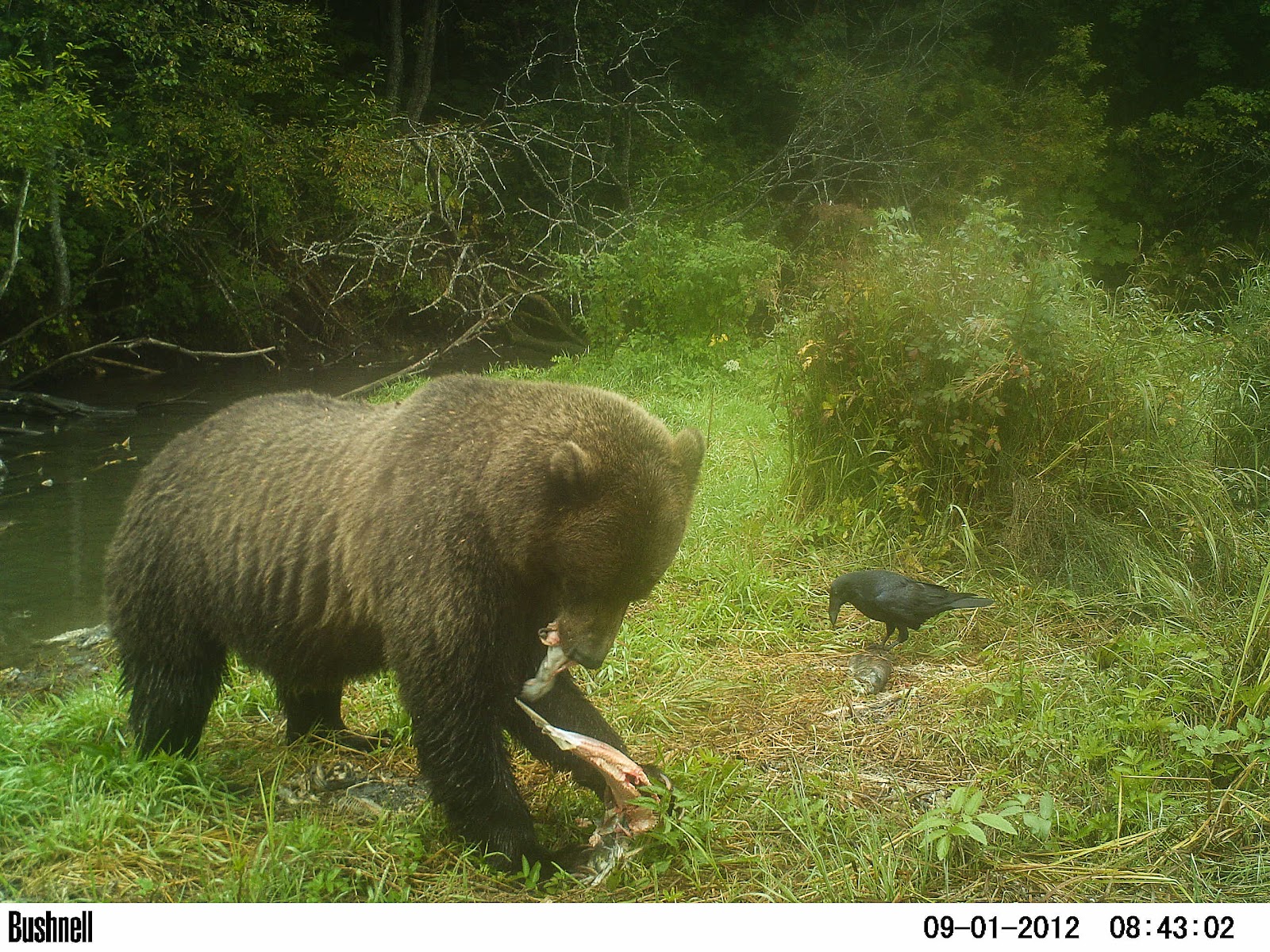
Remember in an earlier post when we discussed high-grading? That's when animals focus on only the highest-grade feed available, ignoring the rest. That's what this bear is doing here: high-grading the sockeye by eating only the skin. The raven is waiting around for the scraps, and won't be disappointed. This bear will leave the remainder of the sockeye carcass, muscle tissue and all, behind and go off to search for more fish brains, roe, and skin, leaving the rest to the scavengers.


This is one of the few photos we've taken of a mustelid (member of the weasel family) in daylight. Not a bad little profile, eh? (As with all the images on our blog, you can click on them to see a larger size.)


These two young bears, probably male siblings, have shown up in several of our trail cameras. Brown bear cubs remain with their mother for two to four years, but don't become sexually mature until they are several years older. Males, in particular, must often wait until they are large and powerful enough to compete with other large males for mates. A large male bear can easily kill a young male, which is why its still safest for these two to stick together.


Raven in-flight! Just a neat little image I thought I'd share.
 

The final image in this post was actually captured a couple weeks ago, but at the time, we were unable to check the photos on the camera-- we walked up on another camera nearby and found that a bear had been feeding there just a few minutes prior to our arrival. Look at the timestamps (in the lower right-hand corner) on these two images:


Fewer than six minutes elapsed before the bear completely disappeared from the field of view of the camera and the first image the camera took of us walking up to the area. With no way of knowing which direction the bear had gone, we decided it was best to leave without checking the last camera that week. Better to risk losing some images than walking back in brushy area on a wary bear.

For that reason, we missed this photo last week. Remember the image of the wolf from the last set of trail camera photos I posted? Turns out it (or another member of the same pack) had visited another one of our cameras in the area a few days earlier. This time, we were lucky enough to capture a much clearer image.


Labels: , , , , , , , , , , , , , , , ,

Thursday, September 13, 2012

The Chum are Coming!

Over the past couple weeks, the Sockeye runs have been slowing down. Most of the Sockeye in the spawning areas have now died, and few new Sockeye appear each day. Carcasses litter the streams, ponds, and banks. We've gradually seen less activity on our trail cameras-- fewer bears are visiting key feeding areas, and we come across fewer partially consumed carcasses along bear trails. But the bears have no need to be concerned. There are plenty of other fish in the stream!

Pink salmon are still running, although their numbers have decreased, too. Coho salmon also continue to spawn, but spawn in much lower densities and across larger areas than Sockeye, so it's more difficult to locate their spawning grounds. The bears' next big target, though (and ours, too, for our trail cameras) are the Chum. Just last week, there were only a few fish in this spawning channel off of Herman Creek. Already, the densities are quickly increasing:


Chum salmon are also called Dog and Keta. Keta is the name typically used by canning companies (after all, who wants to eat "chum" anyway?). Chum and Pink salmon are the least commercially valuable fish. Most commercial fishing and canning operations prefer King and Sockeye, but many subsistence fishers in this region like Chum just fine-- especially when smoked, fresh-caught Chum has good flavor.

Chum salmon spawn in autumn, from roughly the end of August through the winter, or at least until the rivers freeze enough to prevent their travel upstream. Chum spawn by the hundreds of thousands, and much like Sockeye they pack themselves into their spawning areas. Chum can pack themselves in even greater densities than the Sockeye. Sockeye are limited by available fry rearing habitat-- once their eggs hatch the young salmon fry need suitable places to grow for a year or two before migrating to sea. Thus, Sockeye need good places to lay their eggs that are also in areas fit for little fish to grow.

Chum, however, are limited only by spawning habitat. Their fry migrate to sea more or less immediately after hatching. Chum salmon don't need to find suitable places for their fry to grow, only good spots for the eggs to hatch. As long as they can locate nice, rocky substrate with good water flow, they can spawn, so Chum find whatever spawning habitat is available, even if there are already hundreds of other fish around. This makes them easy for wildlife to access. Just walk up to the water and grab one!

With the weather quickly cooling and the Chum beginning to run, the eagles are beginning to congregate. We've started to see far more eagles around Haines recently. Gradually over the next month, the water level of the Chilkat River will drop, exposing the river flats and providing many shallow areas for wildlife to access fish. The Chum run will increase, until the braided areas of the Chilkat are packed with fish. And, as temperatures continue to decrease and freezing begins elsewhere along the coast and in the interior, more and more eagles will travel to Haines to feast on Chum through the beginning of winter.

We will continue to set our trail cameras out to capture wildlife feeding on salmon. At the end of this week, we will take down our last set of trail cameras from the Sockeye runs, and, starting next week, will set our cameras on Chum spawning areas and on higher elevation wildlife trails. Once the eagles begin arriving en mass, we will also start working on the second part of our research here-- looking into eagle migratory behavior!

Labels: , , , , , , , , , , , , , , ,

Wednesday, September 12, 2012

Trivia Question of the Week

This week's Trivia Question comes to you from our trail cameras! It's a little tougher this week:

What type of animal was captured in this photograph?

(You can click the image to view a larger version)

Hint #1: This photo was taken with an infrared flash at night, so colors won't be there to help you.

Hint #2: The animal in question is in the bottom left-hand part of the frame.

Hint #3: It may seem obvious to some, but it's worth pointing out: this animal is nocturnal.

Hint #4: It's facing away from the camera-- what we're seeing here is, predominately, its back.

Hint #5: This animal is a bird of prey.

.
.
.
.
.
.
.
.
.
.

Did you guess Great Horned Owl? If you did, congratulations! Want to helps us identify some other animals?

One of the trickiest aspects of using trail cameras is that the photographs we capture aren't always straightforward. Animals sometimes move quickly across the frame, and the shutter speed of the cameras won't be high enough to prevent motion blur. Sometimes, animals get too close to the cameras and the flash reflects back into the lens, causing white-out or blown highlights. Some animals will be hovering around the edges of the camera's field of view, and only parts of them- tails, feet, the curve of their rump- might end up being captured. Photos taken at night can be particularly difficult because there are no colors. As humans, we rely on colors and color patterns to identify a lot of different animal species-- tough to do when everything is showing in gray-scale!

Did you have difficulty identifying the owl in this photograph? You're not alone. Correctly identifying the species in trail camera photographs is critical for later data analysis, so it can be time consuming and trying to sort through hundreds of photos and pick out the different types of animals in each. Sometimes we find images we really can't identify. With those, we have to do our best to determine the animal's family, at the very least. Is it a mustelid (member of the weasel family, like a mink, marten, ermine, otter, etc.)? Canid (coyote, wolf, fox)? Ursid (brown bear, black bear)?

We also rely a great deal on natural history (knowledge of the animals living in an area and their habits) and contextual cues. For example, wolves aren't likely to be seen close to town, so an shaky image of something dog-like is probably a coyote or domestic dog. River otters won't be found far from water, so an image of a large weasel-like animal captured with a camera on a high altitude trail a mile away from the nearest stream is probably a marten. If one set of photographs is blurry, but there is a photo taken a couple minutes before or afterward of a mink, the blurry photos are probably also mink-- it's uncommon to capture photographs of two completely different animals within a few minutes of one another, unless they're, say, different types of birds feeding along a spawning area.

Here are a few other tricky photos for you to try out:


See the hump in the bottom part of the frame? Any guesses? This one is probably a marten.


In the lower part of the frame, just to the left of center, see the lighter-colored animal against the dark background? This is likely a mink.


See the weasel-like animal just below and left of the center of the photo? This one is probably a mink, too.

If you enjoyed looking at these photos and trying to figure out what you're seeing, you might be able to participate directly in projects like ours in the near future. Yiwei is currently working on developing an interactive game for Facebook that will allow users to work in teams to help tag photos just like these.

Labels: , , , , , , , , , , , , ,

Friday, September 7, 2012

More Trail Camera Photos

We've had our trail cameras up for just two weeks, and we've already been getting some great photos. Check out some pictures from our most recent download!

As usual, there are A LOT of bears:


 Look at the size of that Sockeye!


Who's there!?


Someone needs to lay off the salmon....


It's not all bears, though! Look at this raven and great blue heron:


And my personal favorite picture of the week-- we had a couple of wolves stop by! Here's a shot of one of them:


Labels: , , , , , , , , , , , , , , ,

Sunday, September 2, 2012

Trivia Question of the Week

It's time for the Trivia Question of the Week! This week's question:

How fast can brown bears run?

Hint #1: If a brown bear were running through a School Zone, it would break the speed limit law.

Hint #2: They can't outpace foxes, coyotes, or wolves.

Hint #3: Usain Bolt wouldn't have a chance at beating a brown bear in a sprint.

Hint #4: In a 1 km race against a cheetah, the cheetah would reach the finish line in half the time it would take the brown bear.

Hint #5: A brown bear probably would have made it out of the Boston Molasses Disaster alive.

.
.
.
.
.
.
.
.
.
.


If you guessed 35 miles per hour, you're correct! Brown bears can run at up to 35 mph for a couple miles, and bears have been recorded sprinting at upwards to 40 mph over short distances! Yikes! The fastest human footspeed on record is just under 28 mph, whereas cheetah regularly sprint distances at 70 mph. The take-away message here? Don't run from bears! :)

Labels: , , , ,

Monday, May 21, 2012

Why do eagles migrate thousands of miles to feed on salmon?


Check out the feeding frenzy when the chum salmon arrive in the fall. This is only one half day of footage from our motion detecting cameras! Eagles pull out the salmon and other birds can access whatever is left.


But why do eagles migrate by the thousands to the Chilkat River from distant locations?
Read more »

Labels: , , , , , , , ,

Friday, May 18, 2012

Who are we? (Part 3)

Hey there! My name is Rachel Wheat. I grew up on the front range of the Rocky Mountains in Colorado, and have long been fascinated with wildlife and the natural world. I've worked on a variety of field projects, from researching tree squirrels in Colorado to sage-grouse in Wyoming to gray wolves in Yellowstone National Park. Needless to say, I'm thrilled to be starting this newest research project to study salmon-wildlife interactions near Haines, Alaska!
Read more »

Labels: , , , , , ,

Who are we? (Part 2)

Hello folks, I'm Taal Levi...

I'm about to finish my PhD (7 days until my exit talk!) and begin a National Science Foundation postdoctoral research fellowship to study how interactions among carnivores influence ecosystems and the emergence of human diseases.

Read more »

Labels: , , , ,

Thursday, May 10, 2012

Welcome to Ecology Alaska!

Welcome to the Ecology Alaska blog! We are Rachel Wheat, Yiwei Wang, and Taal Levi.

Here, we will be recording our adventures studying the wildlife of Alaska, starting summer 2012. Check back often as we begin preparations for our research...


Labels: , , , , ,

<data:blog.pageTitle/>

This Page

has moved to a new address:

http://www.ecologyalaska.com

Sorry for the inconvenience…

Redirection provided by Blogger to WordPress Migration Service