Monday, January 21, 2013

Trivia Question of the Week

We learned last week that Pacific salmon can grow to very large sizes when they spawn, but how do they know where to spawn?

If Pacific salmon spend most of their lives in the open ocean, how do they find their natal streams (the streams in which they were born) when they return to freshwater to spawn?

Hint #1: Planetarium studies have indicated that some species of bird rely on celestial navigation, orienting themselves based on the location of specific starts in the night sky. But since salmon can't see the stars, this isn't a tactic they can utilize.

Hint #2: Birds and salmon do have a navigation technique in common, though. It's the same way many animal species, from bats to sea turtles, find their way.

Hint #3: Scientists believe that salmon use not one, but two navigational aids to return from the ocean to their natal streams.

Hint #4: The technique for traversing ocean currents to find their way to freshwater is thought to be different from the method salmon rely on in the streams themselves.

Hint #5: You may think Fido is good at sniffing things out, but he can't compare to a Pacific salmon.

.
.
.
.
.
.
.
.
.
.
Photo credit: Natalie Fobes

The two primary navigational aids salmon rely on are magnetism and scent. When salmon are in the open ocean, scientists believe they travel primarily by orienting themselves with the earth's magnetic field, much like many migrating species, like sea turtles, birds, and bats. Once they reach freshwater, however, scent plays the dominant role in guiding salmon travel. Young salmon migrating out to sea, known as smolts (pictured above), imprint different scents from their environment as they travel downstream. This allows them to create a memory bank of scents, which they later can use as a scent-map of sorts to guide their return to their birthplace as adults.

Labels: , , , , ,

Monday, January 14, 2013

Trivia Question of the Week

This week's trivia question is a little fishy:

How big are Pacific salmon when they spawn?

Hint #1: Trick question, right? There are five species of Pacific salmon that spawn on the west coast of Canada and the US: King, Sockeye, Chum, Pink, and Coho. Different salmon species are different sizes. Kings, for example, typically range from 10-50 lbs (4.5 - 23 kg), whereas Pinks average only 5 lbs (2.3 kg).

Hint #2: Not only are different species different sizes, but older fish are typically (but not always) larger than younger fish.

Hint #3: To make things even trickier, not all salmon are the same age when they spawn. Sockeye can be anywhere from two to six years old when they return from the ocean to freshwater streams for spawning.

Hint #4: With all these variables, perhaps a better question would be, "How large do the largest, oldest Pacific salmon become before spawning?"

Hint #5: King salmon are called "kings" for a reason.

.
.
.
.
.
.
.
.
.
.


The largest King salmon on record was a caught by a commercial fishing operation near British Columbia in the late 1970's. This monster weighed in around 126 lbs (57 kg)! Several King carcasses weighing 100 lbs or more have been found on spawning grounds. The fish pictured above was located by biologists of the California Department of Fish and Game during a salmon survey on Battle Creek. Measuring in a 4.5 ft (1.4 m) long and around 85 lbs (38.5 kg), this King was one for the record books in California.

Labels: , , , , ,

Monday, November 26, 2012

Southward Bound

It's hard to believe, but it's been exactly four months since Rigby and I arrived in Haines on the ferry from Prince Rupert. From the Southeastern Alaska State Fair, to hiking Mt. Ripinsky and the trails in Chilkat State Park, to learning about spawning salmon, subsistence fishing and canning, to setting out trail cameras and finally, trapping and tagging bald eagles, the last four months have been filled with a host of new experiences and opportunities. And bears.


Read more »

Labels: , , , , , , , , , , , , , , ,

Saturday, November 10, 2012

To Catch a Predator (Part 1)

We just finished six intense days of eagle captures! In the coming week, we'll be posting several entries and many photos of our adventures, so check back often. Aided greatly by raptor biologist Steve Lewis of the US Fish and Wildlife Service and Dr. Scott Ford, an avian veterinarian, our efforts netted five total eagles, so we were able to deploy all of our satellite tags!

Eagles surveying the Chilkat River

As the weather turns chillier and the rivers begin to freeze, more and more eagles are congregating along a small stretch of the Chilkat River that hosts open, flowing water. This two- to three-mile stretch of river stays unfrozen year-round as a result of unique geology-- groundwater percolating upward from natural springs near the confluence of the Tsirku, Klehini, and Chilkat Rivers maintains water temperatures just above freezing. Eagles come to this area to access chum and coho salmon. When rivers freeze elsewhere, this spot is one of the only places eagles can find a meal!

Read more »

Labels: , , , , , , , ,

Wednesday, October 24, 2012

More Trail Camera Photos!

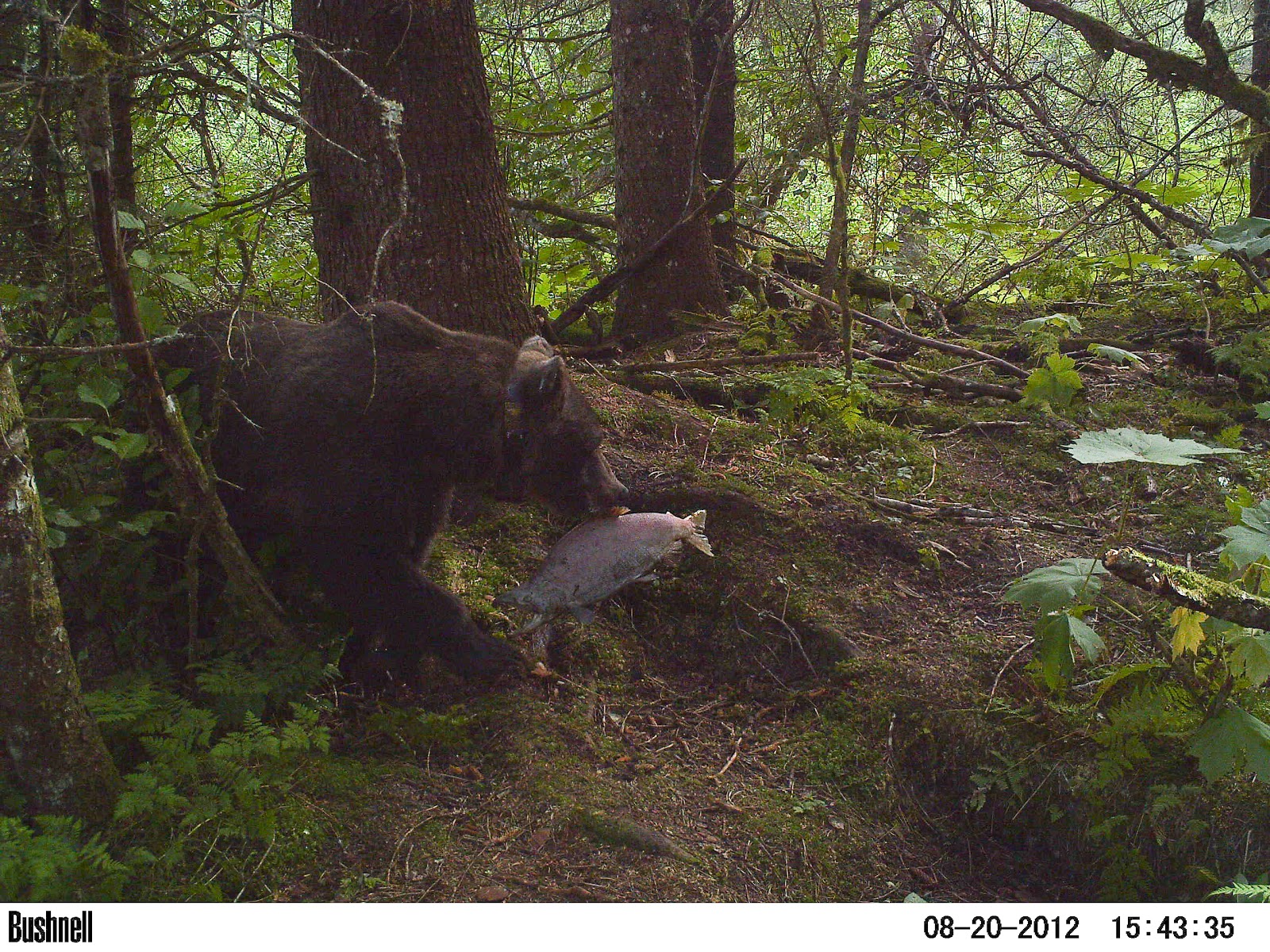
This latest series of trail camera photos comes to you courtesy of the Herman Creek Chum salmon run. Coho and Chum are pretty much the only salmon running this time of year. Coho are a little harder to come by, so anything that's eating salmon is probably going to be eating Chum.

Like these bears:


Or these. How many bears do you see in this photo?


Did you count four? There are the two obvious ones, then part of a third on the right edge of the frame, and part of a sneaky fourth behind the branches along the left edge of the frame.

Here is a less sneaky adult eagle:


and some mergansers and a raven at that same site:


We had a couple coyotes in this set. Here's one of them:


Eagle party! More eagles have been arriving every day. There is a citizen science group in Haines that does weekly eagle counts. Last weekend the tally was 775. It won't be too much longer before there are thousands.


Take a look at this handsome youngster:


We also have some ravens fighting over scraps.


Another photo of a wolf!


And our first moose photo! Well, sort of, anyway.


This last one is tricky. Along the bottom part of the frame in the middle, there is another "first" camera sighting. A rodent! It's impossible to identify the species, or get much beyond "rodent-like small animal." But there it is! Maybe not quite as grand as the brown bears, wolves, and eagles, but I think it's fun to see them just the same.


Labels: , , , , , , , , , , , , , , ,

Thursday, October 18, 2012

Trail Camera Photos: Bear Edition

Hey everyone! Over the past few weeks I've been working hard at sifting through our collection of trail camera photos and tagging them all-- adding digital labels to identify what was recorded in the image. Most weeks we download anywhere from a few hundred to a few thousand photographs off our cameras, so sometimes it takes a while to get through them. We have nearly 15,000 photographs already from this field season, with about five weeks remaining to collect data.

Each photo must be properly tagged with information about the date and location the photo was taken, along with whatever critter(s) may have shown up, in order for us to be able to analyze the data later on. It can be a tedious and time-consuming process, but it's nice to have a searchable database of images. Once tagged, I can easily go back and locate every single photo we have of a marten, a canid, a crow, etc.

So instead of sharing photos from a specific location, this week I decided to share photos of a specific subgroup of subjects: brown bears! We have so many images of bears that it was hard to decide which to share. This is just a sampling of some of the bear pictures we've taken the past couple months:

This was a nice closeup we got at one of our first trapping locations, at the end of August. This is the same place we saw the bear cub and the wolf I posted earlier. This camera had great placement-- just about every photo we got off it was crisp, clear, and in focus.


Here's another earlier image. This is one of two female brown bears that the Alaska Department of Fish and Game monitors-- see her radio collar?

 
This image is more recent, from a set of cameras we have on a run of Chum salmon up Herman Creek.


Another more recent image taken at the same location. This is one of the better nighttime images we have of a brown bear.


Although this one isn't bad, either. But I just realized the clock somehow got reset on this camera, and the time stamp isn't right. Dangit! :\


This bear doesn't look particularly happy to have its photo taken.


Neither does this one. And it has backup!


This bear, however, is pretty fluffy. Not nearly as intimidating.


So many bears!

Labels: , , , , , , , , ,

Thursday, September 27, 2012

Trail Camera Photos!

These are some of the last of the photos from the cameras we set on the Sockeye runs. Since the Sockeye are tapering off and the run is at its end, there are fewer fish, fewer carcasses, and thus fewer animals coming to visit our cameras. Nevertheless, I found a few photos from our final set of Sockeye cameras worth sharing:

Hey look! A marten! In daylight! Almost all of the marten (and mink) photos we get are at night, with the infrared flash. It's really nice to see them in color.


Crow party!


Here's a new one: This is a varied thrush. Varied thrushes are more or less all over the place out here. They are striking birds, with a very distinct grey and orange pattern accented with black and white. They have little interest in our carcasses, but like all thrushes often feed on the ground. You've probably all seen a thrush before-- American Robin are in the thrush family.


Yet another bear photo. We saw very few bears in this last set of images. Most of the photos of were us (setting the cameras) and of mink and marten, with the occasional red squirrel or thrush thrown in the mix. But we did see a couple of bears, this being one of them.


Aaaaaaaaand another wolf photo! I'm very pleased to be seeing wolves in different areas around Haines. The first two photos of wolves I posted were from an area near the confluence of the Kelsall and Chilkat Rivers. This photo was taken near Chilkoot Lake. This appears to be a fairly young animal.
 

Wolves have a tough time living around Haines. There are no deer or elk here. The only large game for packs to hunt is moose, and most of the available moose habitat is much farther up the Chilkat and Chilkoot Rivers and up at higher elevations. Moose are hunted here, and although the moose population is managed to sustain hunting, it is not managed to sustain wolf packs. There is also a lengthy wolf hunting season-- nearly year-round, with a three-month hiatus during summer-- with a limit of five animals. Dedicated wolf hunters could easily disrupt an entire pack.

Many people in the United States are still strong advocates of predator control, and would prefer that wolves aren't around. Some of this is anti-wolf sentiment is interest-based (many game hunters believe that wolves kill a lot of the available prey in an area, meaning fewer animals available for harvest in the fall). Some is likely symbolic (wolves have been portrayed for centuries as something to be feared and destroyed).

Whatever the case, I'm happy to be seeing wolves on our trail cameras. Wolves help sustain healthy populations of their prey, which in turn impacts the vegetation on which herbivores feed. Wolves are often called keystone species-- species which have a disproportionally large impact on their environment, and whose presence helps to balance food webs. A large part of our research involves better understanding the impacts large carnivores, like bears and wolves, have on the environment, and why they are important.

Labels: , , , , , , , , , , , , , , , ,

Thursday, September 13, 2012

The Chum are Coming!

Over the past couple weeks, the Sockeye runs have been slowing down. Most of the Sockeye in the spawning areas have now died, and few new Sockeye appear each day. Carcasses litter the streams, ponds, and banks. We've gradually seen less activity on our trail cameras-- fewer bears are visiting key feeding areas, and we come across fewer partially consumed carcasses along bear trails. But the bears have no need to be concerned. There are plenty of other fish in the stream!

Pink salmon are still running, although their numbers have decreased, too. Coho salmon also continue to spawn, but spawn in much lower densities and across larger areas than Sockeye, so it's more difficult to locate their spawning grounds. The bears' next big target, though (and ours, too, for our trail cameras) are the Chum. Just last week, there were only a few fish in this spawning channel off of Herman Creek. Already, the densities are quickly increasing:


Chum salmon are also called Dog and Keta. Keta is the name typically used by canning companies (after all, who wants to eat "chum" anyway?). Chum and Pink salmon are the least commercially valuable fish. Most commercial fishing and canning operations prefer King and Sockeye, but many subsistence fishers in this region like Chum just fine-- especially when smoked, fresh-caught Chum has good flavor.

Chum salmon spawn in autumn, from roughly the end of August through the winter, or at least until the rivers freeze enough to prevent their travel upstream. Chum spawn by the hundreds of thousands, and much like Sockeye they pack themselves into their spawning areas. Chum can pack themselves in even greater densities than the Sockeye. Sockeye are limited by available fry rearing habitat-- once their eggs hatch the young salmon fry need suitable places to grow for a year or two before migrating to sea. Thus, Sockeye need good places to lay their eggs that are also in areas fit for little fish to grow.

Chum, however, are limited only by spawning habitat. Their fry migrate to sea more or less immediately after hatching. Chum salmon don't need to find suitable places for their fry to grow, only good spots for the eggs to hatch. As long as they can locate nice, rocky substrate with good water flow, they can spawn, so Chum find whatever spawning habitat is available, even if there are already hundreds of other fish around. This makes them easy for wildlife to access. Just walk up to the water and grab one!

With the weather quickly cooling and the Chum beginning to run, the eagles are beginning to congregate. We've started to see far more eagles around Haines recently. Gradually over the next month, the water level of the Chilkat River will drop, exposing the river flats and providing many shallow areas for wildlife to access fish. The Chum run will increase, until the braided areas of the Chilkat are packed with fish. And, as temperatures continue to decrease and freezing begins elsewhere along the coast and in the interior, more and more eagles will travel to Haines to feast on Chum through the beginning of winter.

We will continue to set our trail cameras out to capture wildlife feeding on salmon. At the end of this week, we will take down our last set of trail cameras from the Sockeye runs, and, starting next week, will set our cameras on Chum spawning areas and on higher elevation wildlife trails. Once the eagles begin arriving en mass, we will also start working on the second part of our research here-- looking into eagle migratory behavior!

Labels: , , , , , , , , , , , , , , ,

Tuesday, August 28, 2012

Sockeye

Sockeye salmon (Oncorhynchus nerka) are one of the more desirable species of salmon in Alaska. Sockeye tend to have rich, fatty meat, and their muscle ranges from pink to deep red in color, making it the preferred fish of canneries. In this region, most people that eat fish think King is king-- King salmon have the best flavor of them all-- but Sockeye probably comes a close second.

Sockeye are, in my opinion, the prettiest of the bunch when they're breeding. Males and females both take on a deep red hue, with green heads and tails. They only develop this color scheme when they're spawning. When living in the ocean, and before they begin to spawn, Sockeye are silvery blue. Check out this video of Sockeye on their spawning grounds in Chilkoot Lake:


Remember that Sockeye (like all the salmon we study) are anadromous fishes. Anadromous comes from the Greek word anadromos, meaning "running upward." Anadromous fish spend most of their lives at sea before migrating to freshwater streams and running upriver to breed and die. Most Sockeye spawn between July and August, so we're just seeing the tail end of the Sockeye run around Haines.

Imagine seeing hundreds of fish swimming together in a narrow stream bed or shallow pond just off of a major river:


The setting seems idyllic. Tree boughs overhang the creek, providing shade. The rocky bottom, interspersed with sandy patches, is a great place for a female Sockeye to build a redd (nest), lay her eggs, and attract a male to fertilize her brood. In the spring, her eggs will hatch, and the fry (young fish) will spend up to three years living in this stream, growing, before migrating out to sea*.

But before too long, the strain of migrating anywhere from hundreds to thousands of kilometers, breeding, defending territories and redds, and chasing off competing fish, all without eating, begins to take its toll. During spawning, salmon put all of their energy into breeding. All the normal things that we do on a day-to-day basis to stay alive (eating, for example), and all the things our bodies do to keep us healthy (fight off infections, destroy damaged cells, etc.) salmon neglect in favor of procreation. In fact, by the time salmon reach their spawning grounds, they've already begun the descent to senescence. The salmon start rotting before they've even died.


Can you see this white patches on these salmon? Those are parts of their skin that have died and begun to decompose. Some salmon appear in relatively good condition before they die; others are heavily mottled with patches of decaying flesh. In a short period of time, the idyllic creek filled with spawning fish turns into a apocalyptic wasteland of decomposing salmon carcasses. Bears get to many of them:


Others are left in the stream to decay:


Just one week ago, Jenn and I set our trail cameras in this area and recorded the video of the peaceful stream above. When we returned, seven days later, to check the cameras, we walked into a wasteland of salmon carcasses. What a difference a single week makes! Very quickly the salmon in these areas are finishing their breeding cycle and dying off. It may seem unpleasant (and in fact they do smell terrible) but it is endlessly fascinating. The carcasses these decomposing salmon leave behind will provide valuable nutrients, like nitrogen and phosphorus, to both the stream bed and surrounding terrestrial vegetation. And, of course, they also provide plenty of food for the carnivores!


*Not all salmon species spend extended periods of time as frys in freshwater areas before migrating to sea. Some species spend more time (upwards of four years for some Sockeye), and others, less. Chum salmon, for example, are born in freshwater streams and migrate to sea immediately.

Labels: , , , , , , , , , , ,

Sunday, August 12, 2012

It's Salmon Time!

The salmon are starting to spawn in earnest. Salmon spawn throughout the year, although most species' runs are concentrated between August and December. Different species spawn in different habitats and up different watersheds, at different times of year, so for wildlife that feed on salmon, the entire fall is a veritable smorgasbord of delicious food! Check out this great article published online by the University of Washington about diversity in the way salmon spawn.

There are five different species of salmon that spawn in the eastern Pacific up freshwater rivers and streams along the west coast of the United States: Chum, Coho, Chinook (also known as King salmon), Pink, and Sockeye. 

Yesterday, Jenn, Rigby, Quark and I started scouting areas to set up some of our trail cameras. We wanted to check some Pink and Sockeye spawning areas to make sure there is good fish activity this time of year. Check out this video I took of some Pink salmon spawning in a small creek just off the Chilkat River:


Male and female Pink salmon, as with many species, are sexually dimorphic when they breed. Sexual dimorphism is a term that refers to the fact that males and females have different physical appearances-- Male pink salmon are larger, and grow a hump and hooked jaw, while females remain smaller and streamlined. Pink salmon are also called "Humpies," and I'm sure you can tell why by watching the male Pink salmon in the video above!

There is plenty of evidence of bear activity in these areas. When salmon are high in abundance and bear densities are low, like the Pink salmon at this creek not far outside of Haines, bears high-grade salmon, eating only the most fat-rich parts of the salmon, including the roe (eggs), brains, and sometimes the skin, which often has a fatty layer underneath. Bears then leave the remnants of the salmon carcasses on the stream bank, where they're later accessed by scavengers, or sometimes washed back into the stream.

WARNING! If you don't want to see pictures of dead salmon, don't look below! (But I promise they're not super graphic... this time!)


This is a picture of two Pink salmon, one male and one female, that a bear left on the creek bank. Note that the bear was high-grading these fish: the female, on the left, had only the roe removed; the male, on the right, was missing its brain. Otherwise the carcasses were intact! It may seem wasteful to us, but bears have only a few short months this time of year to put on hundreds of pounds of weight to survive their hibernation during winter. The best way to put on weight is to eat only the fattiest, richest, and most caloric foods. No sense in filling up on muscle-- brains and eggs are the way to go.

We scouted some additional areas yesterday for Sockeye salmon, one which we'll revisit next week to install trail cameras. Before too long, we'll be able to share photos of scavengers that help clean up these leftover carcasses. Until then, you'll have to be content with this scenic picture of Nataga Creek, near its confluence with the Kelsall River.


Labels: , , , , , , ,

Thursday, July 26, 2012

Fantastic PBS documentary about Pebble Mine

The largest gold and copper deposits in North America sit right on top of the world's best salmon run. Learn more about one of the largest ongoing environmental and social battles in this PBS documentary. It is highly informative and presents a fairly unbiased presentation of the issues.

http://video.pbs.org/video/2260099527

Labels: , , , , , ,

Monday, May 21, 2012

Why do eagles migrate thousands of miles to feed on salmon?


Check out the feeding frenzy when the chum salmon arrive in the fall. This is only one half day of footage from our motion detecting cameras! Eagles pull out the salmon and other birds can access whatever is left.


But why do eagles migrate by the thousands to the Chilkat River from distant locations?
Read more »

Labels: , , , , , , , ,

<data:blog.pageTitle/>

This Page

has moved to a new address:

http://www.ecologyalaska.com

Sorry for the inconvenience…

Redirection provided by Blogger to WordPress Migration Service