Thursday, January 17, 2013

Eagle Update

The past couple weeks have seen few changes in the places our GPS tagged eagles have been traveling. The females are still seemingly content to stay on the Chilkat, while the males are still southward in and around Prince Rupert.

The adult female, 3E, and the immature female, 4P, are both right around the area we initially caught them:

3E


4P


The mature male, 3C, is still moving around a bit, bouncing eastward, then westward again, then a bit to the southeast, though he is still near Prince Rupert. You can see pretty clearly on this image how he has been following waterways closely as he travels.

3C


The immature male, 2Z, has now been in Prince Rupert for more than a month. This may be where he stays until spring. It seems 2Z is spending time feeding at a landfill near the city. Since he is a younger bird, he may not be able to compete with other eagles for better food sources (e.g. fish), or perhaps his hunting skills aren't quite up to scratch. Whatever the reason, doesn't appear to be following the salmon, but rather, the dump truck.

2Z


In the upper right hand corner of the photo above, you can see a little portion of 3C's track, where the two birds were near one another for a short time.

Labels: , , , , , , , ,

Thursday, January 10, 2013

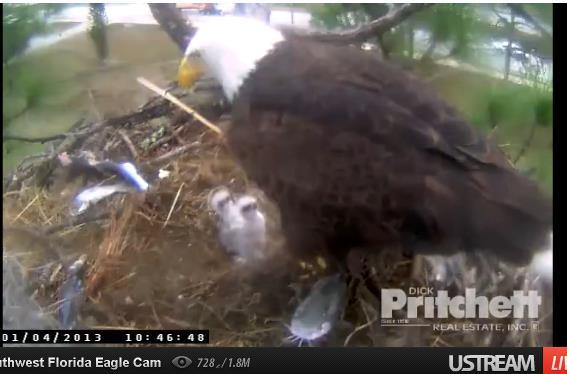
Eagle Nest Camera!

Check out this live-streaming footage of a bald eagle nest in Southwest Florida! The two adult bald eagles, dubbed Ozzie and Harriet, are raising two chicks. One chick hatched on January 1st, and the other made it out of the shell January 3rd. Both parents will care for these babies, sharing the responsibility of hunting for food and keeping them warm. The nestlings will probably stay in the nest until March, so you'll have plenty of time to watch them grow.

Check it out!


Labels: , , , , ,

Monday, January 7, 2013

Trivia Question of the Week

After a one-week hiatus for the holidays (Happy New Year's, everyone!) we're back. This week's trivia question: How many feathers does a bald eagle have?

Hint #1: The average person has about twice as many hairs on their head alone as an eagle has feathers on its entire body.

Hint #2: Just because it's called a "bald" eagle doesn't mean it's actually bald. Bald eagles have feathers on their heads, too.

Hint #3: Eagles have relatively few wing and tail feathers. The long feathers on the wings used for flight? Only 23 on each wing. The tail feathers? 12.

Hint #4: Most of the feathers on an eagle's body are contour feathers, small feathers that give eagles their shape, and down.

Hint #5: The colder the region, the more down feathers an eagle is likely to have. So an bald eagle in Florida probably has fewer total feathers than an Alaskan eagle.

.
.
.
.
.
.
.
.
.
.


If you guessed that bald eagles have an average of 7,000 feathers, right on! This number varies seasonally, as well. During the molting season and in the height of summer, when the weather is warmer, eagles have fewer total feathers because of the loss of down.

Labels: , , , , ,

Thursday, December 27, 2012

Updates: Eagles, 4N, t-shirts

It's time for some updates! First off, a look at where our four GPS-tagged eagles have been hanging out.

Not much has changed in the past couple weeks. Both females, 3E and 4P, continue to spend their time along the Chilkat River. We're beginning to wonder if both of these birds might be residents. There is still plenty of time for them to leave the area and travel southward, but for now it seems as if they are both perfectly happy sticking near Klukwan.

3E:


Read more »

Labels: , , , , , , , , ,

Monday, December 17, 2012

Trivia Question of the Week

This week's trivia question is appropriately related to eagle migration: How far do bald eagles migrate?

Hint #1: It's not nearly as far as an arctic tern

Hint #2: We've determined these distances through the use of leg bands and telemetry.

Read more »

Labels: , , , , , , , ,

Thursday, December 13, 2012

Eagle Update!

Although 4N's tag is out of commission, we still have four birds to follow! We're always excited to see where these eagles are moving, and we hope you are, too.

First up, the females! Both females, 3E, the adult, and 4P, the immature eagle, have been sticking around the Chilkat Valley.

3E has made a couple trips to the ridgeline south of the Chilkat, but is otherwise hanging out around the area between 19- and 21-mile on the Haines Highway-- pretty much the only region of the Chilkat River that is unfrozen this time of year:


Read more »

Labels: , , , , , , , ,

Monday, December 10, 2012

4N

Rigby and I are back in Santa Cruz, adjusting to things we haven't seen in a while-- stoplights, traffic, and sunshine, just to name a few. We've finally managed to get internet up and running in our new place, so it's back to blogging!

Today's entry focuses on one of the more frustrating aspects of working with wild animals: data loss. So far, we've been getting pretty reliable information from the GPS tags on our eagles, but the data are not without problems. Since the tags are solar powered, they need to have reliable sunshine to keep the battery charged and the device functioning. In southeast Alaska, where snow is a daily occurrence and daylight hours are rapidly diminishing, it's tough for the tags to get the juice they need. This is complicated by the fact that the Chilkat River is surrounded on both sides by relatively steep mountain ranges. Even when the sun does come out, much of the river is still in shadow.

Read more »

Labels: , , , , , , , , ,

Wednesday, November 28, 2012

Trivia Question of the Week, and what's up next

This week's trivia question is paired with statistics for this season's fieldwork. What is the animal we saw most frequently on our trail cameras this summer?

Hint #1: This contest was pretty close, with a couple hundred pictures or so separating the first and second most frequently sighted animals.

Hint #2: In broad terms, the second most frequently sighted type of animal actually beats out the first, but in terms of species, there is one clear winner.

Hint #3: Their name starts with "B"

Hint #4: They're furry

Hint #5: If you anger them, they'll eat your face off. :)

.
.
.
.
.
.
.
.
.
.


If you guessed Brown Bear, you're correct! You've obviously been following along with us this season. Or you know that bears will eat your face off. Either way, congratulations!

"Bears" as a broad category, was actually beat out by "birds"-- we saw more birds overall on our trail cameras than bears. Whereas the "bird" category is composed of eagles, raven, magpies, crows, mergansers, blue-winged teals, varied thrushes, and others, however, the "bears" category is all brown bears. We didn't see a single black bear on our trail cameras this season.

For our trail camera work this summer and fall, we captured:
  • 24,767 photographs, total
  • 6,605 images of bears
  • 7,841 photos of birds
  • 71 photos of canids (wolves, coyotes, and domestic dogs)
  • 332 mustelid photos (mink and marten)
  • 59 photos of rodents (mice and red squirrels)
  • 94 photos of humans (not including ourselves)
  • 0 photos of lynx, wolverine, black bear, or lagamorphs (hares or rabbits), although these species all live in the area

Now that I'm headed back to Santa Cruz and our field season is over for the year, you may be wondering what's in store for the blog. Will I keep updating? What can you expect to see?

Well, by my calculations I've shared around 60 of our trail camera photos here on the blog. That means there are an additional 24,707 photos I could post! :)  I'll continue to post trail camera photos from time to time, in addition to videos I'm currently working on putting together that detail sequences of trail camera photographs, like bears or eagles feeding on the salmon carcasses.

And don't forget about our eagles! We'll continue to follow the movements of the five eagles we tagged with GPS/satellite transmitters, and we'll post these locations for you as we go along.

There are several other stories from the field that I haven't yet had time to put together into blog entries that I'm hoping to work in within the next couple of months. We're also working on putting together a fully-fledged website for Ecology Alaska. So among trail camera photos, eagle movement data, stories from our fieldwork in Haines, and perhaps a few entries detailing the life of a wildlife biologist outside of the field season, there should be plenty going on here on the blog. I imagine that the rate of posting will decrease come the beginning of the year, but I will attempt to continue posting at least one entry and one trivia question each week.

Stay tuned, and as always, feel free to let us know what you think, by leaving us a message in the comments or sending us an email at ecologyalaska [at] gmail (dot) com.

Labels: , , , , , , , , ,

Saturday, November 24, 2012

Where are they now? (cont.)

The male eagles we tagged, 3C and 2Z, have been busy! Unlike the females, the males have been traveling around a bit more. We suspect this is because males, who are significantly smaller than the females, aren't able to compete as well for food.

3C, the adult male, is still in the Chilkat Valley, although he's been wandering away from the river itself:

Read more »

Labels: , , , , , , ,

Thursday, November 22, 2012

Where are they now?

The great thing about attaching satellite transmitters to our eagles is that the information is fed to us on a regular basis. If the eagles leave the area, we won't have to worry about tracking them by foot or in a plane-- the satellites will download the GPS locations of the birds and we can access the information online. Our transmitters collect a GPS location every hour during daylight, and we receive a list of the locations every two to four days. This means that we're already seeing where our eagles are moving!

Read more »

Labels: , , , , , , , ,

Wednesday, November 14, 2012

Meet the eagles!

Get ready to meet our eagles! We captured five eagles on the Chilkat River this year, and we'll be tracking their movements from now until the transmitters fail (or fall off, or the eagle... dare I say it?... dies)(Which is not going to happen. I hope.). If all goes as planned, we'll see the daily movement patterns of these eagles for at least the next three years! We can't wait to see where they spend their time during different parts of the year.

We captured our first eagle late morning on Saturday, November 3rd, using the ballistic net. A sick juvenile eagle couldn't resist the free food in front of our net launcher, and began to feed. An adult eagle came and roused the juvenile off the bait, and fed in its place. The result? We netted our first bird, a healthy, hefty adult female!

4N, just after being freed from the net

Read more »

Labels: , , , , , , ,

Monday, November 12, 2012

To Catch a Predator (Part 2)

Our snares are set, our net is at the ready, and we've been standing around in the snow since dawn, waiting for the eagles to come in. We keep a close eye on our snares and bait with binoculars and spotting scopes.


Each time an eagle nears a perch we've erected, or flies over the bait in front of our net launcher, we hold our breaths. Typically, the eagle moves on, or perches nearby. We sigh, and wait for the next close encounter.

Then, unexpectedly, an eagle flies down and lands next to the chum carcass set out in front of our ballistic net. It looks around, cautiously, before beginning to feed. We wait until the eagle has its head down, focused on tearing a nice, juicy bit of chum off the carcass, and then-- "Fire!" We trigger the ballistic net remotely, and the .22 gauge blanks power three padded projectiles, launching the net from its housing out and over the bird.

"We got it!"

Everything is a rush. We sprint from the roadside, where we've been watching, down the river embankment to our freshly-netted eagle. We must move quickly, to ensure that the eagle doesn't escape from the net, or get too tangled. Immediately, we secure the talons of the eagle in our hands, and place a hood over its eyes. Eagles receive most of their sensory information visually, so when they can see what we're doing, they get stressed. With the hood on, however, they immediately calm down, and are relatively docile in the hand. Unlike many mammals, birds do not need to be anesthetized during handling. The hood keeps the eagles calm enough.

We then begin the process of extracting the eagle from the net. Here, Steve Lewis and Dr. Scott Ford work the netting off the eagle's wings.

Steve and Scott work the netting off the eagle
Read more »

Labels: , , , , , , , , ,

Saturday, November 10, 2012

To Catch a Predator (Part 1)

We just finished six intense days of eagle captures! In the coming week, we'll be posting several entries and many photos of our adventures, so check back often. Aided greatly by raptor biologist Steve Lewis of the US Fish and Wildlife Service and Dr. Scott Ford, an avian veterinarian, our efforts netted five total eagles, so we were able to deploy all of our satellite tags!

Eagles surveying the Chilkat River

As the weather turns chillier and the rivers begin to freeze, more and more eagles are congregating along a small stretch of the Chilkat River that hosts open, flowing water. This two- to three-mile stretch of river stays unfrozen year-round as a result of unique geology-- groundwater percolating upward from natural springs near the confluence of the Tsirku, Klehini, and Chilkat Rivers maintains water temperatures just above freezing. Eagles come to this area to access chum and coho salmon. When rivers freeze elsewhere, this spot is one of the only places eagles can find a meal!

Read more »

Labels: , , , , , , , ,

Monday, November 5, 2012

Coming soon...!

Things have been quiet here on the blog lately, but don't worry. There's a reason. A very good reason, in fact.

We've been out. Working from dawn to dusk. Trapping bald eagles.

Yep.

More soon- with plenty of pictures!

Labels: , , , ,

Sunday, October 21, 2012

Trivia Question of the Week

With plenty of eagles here already and more on the way, this week's question is appropriately eagle-themed.

What is the grip strength of an adult bald eagle?

Hint #1: The tendons in bird's legs have tiny ridges on them that interlock with the tendon sheaths when flexed, holding the talons closed without any additional effort on the part of the bird. Ever wonder why birds don't fall off branches while they're sleeping? It's because the tendons in their feet are locked in place.

Hint #2: The largest species of eagle in the world, the Harpy Eagle, has enough grip strength to crush the bones of large mammals.

Hint #3: Bald eagles may not be able to crush large mammal bones, but they can definitely do some damage to a human wrist.

Hint #4: Their grip strength allows them to pull salmon equal to their own weight from the water.

Hint #5: An eagle's grip strength is more than 10 times that of a human hand.

.
.
.
.
.
.
.
.
.
.


If you guessed 400 pounds per square inch (psi), then you are a true ornithology nerd champion and know far more about bald eagles than is healthy anyone else. The grip strength of the average adult human, by comparison, is only about 20 psi.


Labels: , , , , , ,

Sunday, September 30, 2012

Trivia Question of the Week

This week's question:

What is the heaviest species of bird in North America?

Hint #1: Although the largest species of bird in North American is the California Condor, this bird has condors beat in the heavyweight category.

Hint #2: Most of their range is centered in Alaska and western provinces in Canada, but they can also be found in parts of Idaho, Wyoming, South Dakota, Nebraska, Michigan, Iowa, and Minnesota, among other locales in the northern US.

Hint #3: Along with being the heaviest bird in North America, this species is the largest extant (still in existence) species of waterfowl in the world.

Hint #4: These animals are large and slow moving, but are often associated with beauty and grace.

Hint #5: They are white.

.
.
.
.
.
.
.
.
.
.

If you guessed Trumpeter Swan, then you are correct. The average weight of adult trumpeter swans is between 15 and 30 pounds. These birds often mate for life, and can have a lifespan over 20 years in the wild. Because of their large size and slow flight, trumpeter swans were extensively hunted in the 19th and 20th century, and were extirpated from large parts of their former range. Today, Alaska maintains the largest number of breeding pairs of these birds. Why are they called trumpeter swans? They have a unique and somewhat melodic honk, of course, a bit like a trumpet:


Curious about how trumpeter swans compare in size to bald eagles? Check out this incredible series of photographs captured by photographer Tom Carver in British Columbia of a bald eagle attacking a trumpeter swan in flight!

Labels: , , , ,

Thursday, September 27, 2012

Trail Camera Photos!

These are some of the last of the photos from the cameras we set on the Sockeye runs. Since the Sockeye are tapering off and the run is at its end, there are fewer fish, fewer carcasses, and thus fewer animals coming to visit our cameras. Nevertheless, I found a few photos from our final set of Sockeye cameras worth sharing:

Hey look! A marten! In daylight! Almost all of the marten (and mink) photos we get are at night, with the infrared flash. It's really nice to see them in color.


Crow party!


Here's a new one: This is a varied thrush. Varied thrushes are more or less all over the place out here. They are striking birds, with a very distinct grey and orange pattern accented with black and white. They have little interest in our carcasses, but like all thrushes often feed on the ground. You've probably all seen a thrush before-- American Robin are in the thrush family.


Yet another bear photo. We saw very few bears in this last set of images. Most of the photos of were us (setting the cameras) and of mink and marten, with the occasional red squirrel or thrush thrown in the mix. But we did see a couple of bears, this being one of them.


Aaaaaaaaand another wolf photo! I'm very pleased to be seeing wolves in different areas around Haines. The first two photos of wolves I posted were from an area near the confluence of the Kelsall and Chilkat Rivers. This photo was taken near Chilkoot Lake. This appears to be a fairly young animal.
 

Wolves have a tough time living around Haines. There are no deer or elk here. The only large game for packs to hunt is moose, and most of the available moose habitat is much farther up the Chilkat and Chilkoot Rivers and up at higher elevations. Moose are hunted here, and although the moose population is managed to sustain hunting, it is not managed to sustain wolf packs. There is also a lengthy wolf hunting season-- nearly year-round, with a three-month hiatus during summer-- with a limit of five animals. Dedicated wolf hunters could easily disrupt an entire pack.

Many people in the United States are still strong advocates of predator control, and would prefer that wolves aren't around. Some of this is anti-wolf sentiment is interest-based (many game hunters believe that wolves kill a lot of the available prey in an area, meaning fewer animals available for harvest in the fall). Some is likely symbolic (wolves have been portrayed for centuries as something to be feared and destroyed).

Whatever the case, I'm happy to be seeing wolves on our trail cameras. Wolves help sustain healthy populations of their prey, which in turn impacts the vegetation on which herbivores feed. Wolves are often called keystone species-- species which have a disproportionally large impact on their environment, and whose presence helps to balance food webs. A large part of our research involves better understanding the impacts large carnivores, like bears and wolves, have on the environment, and why they are important.

Labels: , , , , , , , , , , , , , , , ,

Monday, September 24, 2012

Autumn

This past Saturday, the 22nd, was the official first day of autumn. Having grown up in Colorado, autumn has long been my favorite season. Autumn days in the Rockies are mild, sunny, and warm, a wonderful relief from the blisteringly hot days of summer. Nights are crisp and cool. And the colors! Aspen, cottonwood, willow, and maple turning stunning shades of yellow. I missed autumn a lot when I moved to California.

Fall weather in northern California is nice, too. Sunny, not as much fog in the mornings, and warm. But most deciduous trees there keep their leaves year-round, the evenings aren't cool, and there is no nip in the air that suggests impending snow. It's just doesn't feel right. :\

Luckily for me, Alaskan autumns are a lot like Colorado (except with more clouds, humidity, and rain). Gorgeous colors, blankets of yellow, orange, and the occasional red, have spread across the landscape these past few weeks. Temperatures have dropped. Some afternoons, when the breeze is right, you can stand in a shower of gold as leaves falling from trees catch the pale sunlight.

I love autumn.

The eagles are arriving! Each day more and more eagles appear along the Chilkat, staked out on the river flats to feed on the first of the Chum. What makes for a better photograph than golden cottonwood leaves, blue mountains, and an eagle?


For a couple weeks, the weather here was overcast and rainy almost every day. We literally did not see the sun shine for ten days or more. A bit depressing, and a sure sign of the winter to come. Luckily, late September has been kind to us, and we've hit a string of wonderfully sunny days. It's nice to see some blue sky again!


Before the snow travels low enough in altitude to make mountain travel tricky, we decided to make one last trip up to the alpine tundra. Here is a view of the Klehini River from Flower Mountain. Autumn colors make their way into the highest reaches here-- just look at those deep reds of the low-growing plants. Tundra soils are thin (four inches or less in some places), but vegetation still manages to take hold. Alpine berries, willow, lichens, and scraggly, stunted spruce make their homes here, providing food for mountain goats, moose, songbirds, and alpine ground squirrels.

Quite a view, eh?


With a string of sunny days, we've also been making good use of the raft. Rafting down the Klehini affords us opportunities to set trail cameras south and west of the Chilkat, where we see evidence in tracks of moose, wolves, and the ever-present bear. There are plenty of eagles on the Klehini as well!


Mountains, river, blue sky, and birch, cottonwood, alder, and willow changing colors? Alaska, you are wonderful.


And eagles! More and more eagles! The yellow background of these cottonwood leaves may be a bit distracting in this photo, but the colors sure do make it stand out.


Alaska isn't the only pretty place this time of year. Canada has its fair share of gorgeous locales, too. How about this view of Dezadeash Lake, in the Yukon Territory?


Or this lovely little trail, on the route back from St. Elias Lake in Kluane National Park?


Not enough autumn for you? Oh, all right. Here's one last picture: The Tatshenshini Valley.


Be honest now-- who's in the mood for pumpkins, cider, sweaters, or a bit of Halloween fun? Butternut squash ravioli? Homemade applesauce? Pumpkin-spice latte?

Or how about, for those of you lucky enough to live in places where there's an actual autumn, a bit of time spent outdoors enjoying the leaves.

Labels: , , , , , , , , , ,

Saturday, August 25, 2012

Trivia Question of the Week

Alright, time for the trivia question of the week! This week's question:

What is the largest bird in the United States?

Hint #1: The species neared extinction in the 1970s

Hint #2: The decline was likely caused by a combination of factors: habitat loss, poisoning, and lead ingestion

Hint #3: They have a wingspan of over 10 feet, can weigh up to 30 pounds, and can live up to 60 years in the wild

Hint #4: They are scavengers

Hint #5: They live in California

.
.
.
.
.
.
.
.
.
.
 

If you guessed California Condor (Gymnogyps californianus), you're correct! California Condor once ranged over the entire western United States, but today they're one of the most endangered species in the world, and their habitat is limited to parts of California and Arizona. Just over 100 birds live in the wild, and most of these were captive-bred animals that are still very closely monitored and regularly fed. The photo above is an image of a California Condor in Grand Canyon National Park.

So, was that a trick question? ;)

The Bald Eagle (Haliaeetus leucocephalus) is no lightweight either-- it's the largest raptor (bird of prey) in the United States. With a wingspan between 6 and 8 feet in length and weights ranging between 7 and 14 pounds, Bald Eagles may not be as large or hefty as California Condors, but they are definitely big birds. Just check out the size of their tracks!


Labels: , , , , ,

<data:blog.pageTitle/>

This Page

has moved to a new address:

http://www.ecologyalaska.com

Sorry for the inconvenience…

Redirection provided by Blogger to WordPress Migration Service